

Subject: Indian Economy: Employment, Labour Market and Statistics|Target exams: UPSC, SSC
Key points for Prelims: Periodic Labour Force Survey (PLFS), Labour Force Participation Rate (LFPR), Worker Population Ratio (WPR), Unemployment Rate (UR), Current Weekly Status (CWS), National Statistical Office (NSO)
Mains syllabus mapping
- General Studies Paper 3: Indian Economy: employment generation, unemployment, labour market indicators, statistical systems
- General Studies Paper 2: Government policies and interventions for development in sectors and issues arising out of their design and implementation (data-based policy monitoring)
Key facts for one-day exams
- The PLFS is conducted by the National Statistical Office (NSO) under the Ministry of Statistics and Programme Implementation (MoSPI).
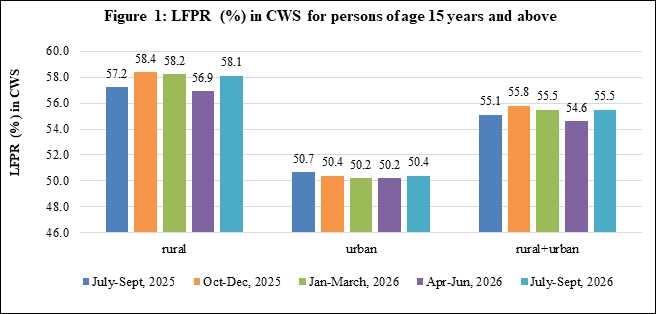
- Overall LFPR for persons aged 15+ years was 55.5% in July-September 2026.
- Overall WPR for persons aged 15+ years was 52.7% in July-September 2026.
- Rural UR declined to 4.3% from 4.8% in the previous quarter.
- The PLFS revamp from January 2025 extended quarterly coverage to rural areas.
Why in the news?
The PLFS Quarterly Bulletin for July-September 2026 shows India's labour market improving: overall LFPR rose to 55.5%, overall WPR increased to 52.7%, and rural UR declined to 4.3%. The survey now covers both rural and urban areas under the revamped Current Weekly Status framework.
Summary
- The PLFS, conducted by the National Statistical Office (NSO) under the Ministry of Statistics and Programme Implementation (MoSPI), is India's primary source of employment-unemployment data.
- The survey was revamped from January 2025 to provide monthly and quarterly estimates for both rural and urban areas under the Current Weekly Status (CWS) framework.
- Overall LFPR for persons aged 15+ years increased to 55.5% in July-September 2026 from 54.6% in the previous quarter, driven by increases in both rural and urban LFPR. Rural LFPR rose to 58.1%.
- Rural UR declined to 4.3% from 4.8% in the previous quarter, while urban UR remained stable at 6.8%.
- The share of rural workers in agriculture increased by 3.8 percentage points quarter-on-quarter to 56.7% during July-September 2026.
Background
The Periodic Labour Force Survey (PLFS) is India's official household survey for tracking employment and unemployment. Before January 2025, PLFS quarterly bulletins covered only urban areas. The revamp extended coverage to rural areas and introduced monthly estimates, using the Current Weekly Status (CWS) framework to generate high-frequency labour indicators.
Key Analysis and Impact
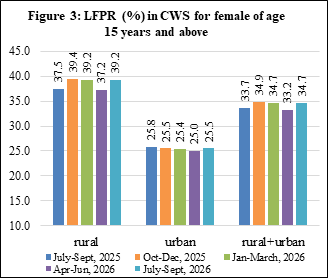
The July-September 2026 data shows broad-based labour market improvement. Overall LFPR rose 0.9 percentage points quarter-on-quarter to 55.5%, with rural LFPR increasing 1.2 percentage points to 58.1%. The rural UR fell from 4.8% to 4.3%, while the overall UR improved to 5.1%. Female LFPR rose to 34.7% from 33.2%, indicating rising women's workforce participation. The shift towards self-employment in rural areas (62.7%) and regular wage/salaried work in urban areas (49.6%) suggests structural changes in employment patterns.
Way Forward
The PLFS revamp enables more timely and granular monitoring of India's labour market. Continued focus on skill development, formalisation of the workforce, and sectoral diversification will be needed to sustain employment gains. The quarterly data will feed into policy formulation for employment generation programmes like PMKVY and MGNREGA.
Key PLFS Indicators: July-September 2026 vs Previous Quarter
| Indicator | April-June 2026 | July-September 2026 | Change |
|---|---|---|---|
| Overall LFPR | 54.6% | 55.5% | +0.9 pp |
| Overall WPR | 51.7% | 52.7% | +1.0 pp |
| Overall UR | 5.4% | 5.1% | -0.3 pp |
| Rural UR | 4.8% | 4.3% | -0.5 pp |
Mains practice questions
Question 1(GS-3 | 250 words | 15 marks)
The PLFS quarterly data for July-September 2026 shows overall LFPR rising to 55.5% and rural unemployment falling to 4.3%, while the survey now covers both rural and urban areas under the revamped Current Weekly Status framework. Critically examine whether these headline improvements reliably indicate a healthy labour market, and discuss the role of survey design in interpreting such indicators.
Answer outline
- Introduction: Open by noting that a rise in LFPR alongside a falling unemployment rate appears positive, but that labour indicators must be read together and against survey methodology before drawing conclusions.
- Body:
- Explain what the improvement signals: higher LFPR and WPR suggest more people are seeking or finding work, and the fall in rural UR to 4.3% points to easing rural joblessness.
- Caution that rising LFPR can reflect distress-driven entry of women and youth into low-paid, informal or self-employment rather than quality jobs.
- Highlight that headline UR does not capture underemployment, informality, wage levels or social security coverage, so a low UR can mask weak employment quality.
- Discuss the significance of the revamped PLFS: the shift to Current Weekly Status and the inclusion of urban areas improve comparability and coverage, but care is needed when comparing with pre-2025 series.
- Note the value of high-frequency quarterly data for policy monitoring, while stressing the need for complementary indicators such as earnings, job quality and sectoral employment.
- Conclusion: Conclude that the PLFS improvements are encouraging but should be treated as a starting point, with policy assessment resting on a broader set of job-quality indicators and consistent long-run methodology.
Question 2(GS-2 | 150 words | 10 marks)
Discuss how a regular, high-frequency labour force survey such as the PLFS can strengthen evidence-based policymaking in India, and examine the challenges in ensuring the reliability and timeliness of such official statistics.
Answer outline
- Introduction: Begin by linking the quarterly PLFS bulletin to the need for timely, reliable data to design and monitor employment policy.
- Body:
- Benefits: quarterly estimates allow governments to track labour market shifts in near real time, evaluate schemes and respond to slowdowns faster than annual surveys permit.
- Institutional role: MoSPI and the NSO produce the data, supporting transparency and a common evidence base for the Centre and states.
- Challenges: maintaining sample quality across rural and urban areas, building capacity for field surveys, and ensuring consistent methodology when frameworks are revised, as with the 2025 revamp.
- Concerns about public trust, data coverage gaps and the need for statistical autonomy and adequate funding.
- Conclusion: Conclude that robust, timely labour statistics are indispensable for evidence-based employment policy, provided methodological consistency and institutional credibility are sustained.
Background GK
Textbook concepts you need to understand this news
- Labour Force Participation Rate (LFPR)
- The percentage of the population (aged 15 years and above) that is either employed or actively seeking employment.
- Worker Population Ratio (WPR)
- The percentage of the population (aged 15 years and above) that is currently employed.
- Unemployment Rate (UR)
- The percentage of the labour force that is unemployed but actively seeking work.
- Current Weekly Status (CWS)
- A reference period of one week used in PLFS to classify a person as employed if they worked for at least one hour on any day during the week.
- National Statistical Office (NSO)
- The statistical organisation under MoSPI that conducts large-scale sample surveys including PLFS, Consumer Expenditure Survey, and Annual Survey of Industries.
Facts to remember
Tap a card to see the answer. Try to recall it first.
How exams will ask this
- Data: Overall LFPR 55.5%, WPR 52.7%, UR 5.1% for July-September 2026.
- Data: Rural UR declined to 4.3% from 4.8% in the previous quarter.
- Nodal Body: Ministry of Statistics and Programme Implementation (MoSPI).
- Data: PLFS revamp started from January 2025, extending coverage to rural areas.
Common mistake:
Examiners may swap 'LFPR' with 'WPR' or 'UR' in questions, or state that PLFS covers only urban areas even after the 2025 revamp. The correct fact is that since January 2025, PLFS provides monthly and quarterly estimates for both rural and urban areas.
Write these in mains answers
- PLFS, CWS framework, labour formalisation, female LFPR, structural shift in employment
Stuck? Get it in one tap
The Periodic Labour Force Survey is a government survey that tracks how many people are working or looking for work. The latest data for July-September 2026 shows that more people are participating in the workforce (LFPR up to 55.5%) and more are employed (WPR up to 52.7%). Unemployment fell in villages to 4.3%.
- Economy: Employment and Unemployment
- Governance: Data Collection and Surveys
Related concepts: Labour Force Participation Rate (LFPR), Worker Population Ratio (WPR), Unemployment Rate (UR), Current Weekly Status (CWS)
Practice questions
Pick an answer, then read the explanation.
- Q1Easy
Which ministry is responsible for conducting the Periodic Labour Force Survey (PLFS)?
Explanation: The PLFS is conducted by the National Statistical Office (NSO) under the Ministry of Statistics and Programme Implementation (MoSPI). The Ministry of Labour and Employment deals with labour policy and welfare schemes, not the survey itself.
- Q2Hard
Consider the following statements regarding the Periodic Labour Force Survey (PLFS):
- 1. The PLFS provides estimates of Labour Force Participation Rate (LFPR), Worker Population Ratio (WPR), and Unemployment Rate (UR).
- 2. The PLFS revamp from January 2025 extended quarterly coverage to rural areas for the first time.
- 3. The PLFS uses the Usual Status (ps+ss) framework for all its quarterly estimates.
Which of the statements given above is/are correct?
Explanation: Statement 1 is correct: PLFS provides LFPR, WPR and UR. Statement 2 is correct: the revamp from January 2025 extended quarterly estimates to rural areas. Statement 3 is incorrect: the quarterly estimates are provided under the Current Weekly Status (CWS) framework, not Usual Status. Annual estimates use both Usual Status and CWS.
- Q3Medium
What was the overall Labour Force Participation Rate (LFPR) for persons aged 15 years and above in India during July-September 2026?
Explanation: The PLFS bulletin for July-September 2026 reported overall LFPR at 55.5%, an increase from 54.6% in the previous quarter. 55.1% was the LFPR in July-September 2025, and 58.1% is the rural LFPR for the current quarter.
- Q4Medium
What is the primary objective of revamping the Periodic Labour Force Survey (PLFS) from January 2025?
Explanation: The revamp aimed to generate high-frequency labour force indicators with wider coverage, providing monthly and quarterly estimates for both rural and urban India under the CWS framework.
Frequently asked questions
1. What is the Periodic Labour Force Survey (PLFS)?
The PLFS is India's official household survey conducted by the National Statistical Office (NSO) under the Ministry of Statistics and Programme Implementation to measure employment and unemployment.
2. What does LFPR stand for and what was its value in July-September 2026?
LFPR stands for Labour Force Participation Rate. For persons aged 15 years and above, it was 55.5% in July-September 2026.
3. How did the rural unemployment rate change in the latest PLFS bulletin?
The rural unemployment rate declined to 4.3% in July-September 2026 from 4.8% in the previous quarter.
4. When was the PLFS revamped to include rural areas in quarterly bulletins?
The PLFS was revamped from January 2025, and the first quarterly bulletin covering both rural and urban areas was for April-June 2025.
All sources
 Original10 November 2026 · Read story
 Merged10 November 2026 · Read story


