

Source: PIB
Subject: Indian Economy: Financial Inclusion, Rural Livelihoods and Women Empowerment|Target exams: UPSC, Bank
Key points for Prelims: NABARD, DAY-NRLM, Interest Subvention Scheme for women SHGs, Women Enterprise Acceleration Fund (WEAF), Single nodal agency, Interest Subvention Portal
Mains syllabus mapping
- General Studies Paper 3: Inclusive growth, financial inclusion, credit for MSMEs and rural livelihoods, role of NABARD
- General Studies Paper 2: Government schemes and welfare programmes for women and vulnerable sections, role of Ministry of Rural Development
Deendayal Antyodaya Yojana-National Rural Livelihoods Mission (DAY-NRLM): quick facts
- Design approach
- Mission mode, demand-driven; states prepare their own livelihoods-based action plans within allocations based on inter-se poverty ratios
- Parent ministry
- Ministry of Rural Development; implemented by the Department of Rural Development (DoRD)
- Single nodal agency
- NABARD, for credit support under the Interest Subvention Scheme for women SHGs and the Women Enterprise Acceleration Fund (WEAF)
Key facts for one-day exams
- NABARD will be the single nodal agency for both DAY-NRLM credit-support schemes.
- The Interest Subvention Portal was launched on 25 November 2026.
- More than ₹14 lakh crore in formal credit has been mobilised for SHGs.
- The additional five-year SHG credit aim is ₹10 lakh crore.
- The five-year credit aim for individual enterprises is ₹1 lakh crore.
Why in the news?
The signing of the agreement and the launch of the Interest Subvention Portal on 25 November 2026 formalise NABARD as the single nodal agency for DAY-NRLM credit support, with a five-year target of ₹11 lakh crore in additional credit for women SHGs and individual enterprises.
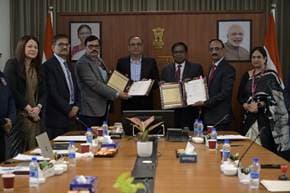
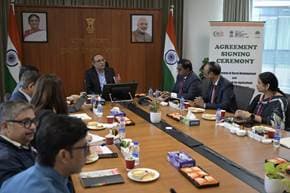
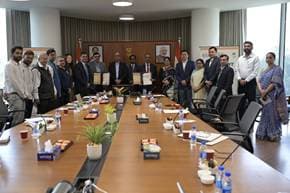
The Department of Rural Development (DoRD) and the National Bank for Agriculture and Rural Development (NABARD) signed an agreement on 25 November 2026 under which NABARD will serve as the single nodal agency for the Interest Subvention Scheme for women Self Help Groups and the Women Enterprise Acceleration Fund (WEAF) under the Deendayal Antyodaya Yojana National Rural Livelihoods Mission (DAY-NRLM). The agreement was signed by Additional Secretary Vipin Kumar and Deputy Managing Director Ajay Kumar Sood in the presence of Secretary Rohit Kansal and NABARD Chairman Dr. Shaji Krishnan V, who also jointly launched the Interest Subvention Portal.
Secretary Rohit Kansal said that over ₹14 lakh crore in formal credit has already been mobilised for SHGs, steadily replacing informal sources. Over the next five years, the department aims to facilitate an additional ₹10 lakh crore for SHGs and ₹1 lakh crore for individual enterprises. “Interest subvention will make credit more affordable, reimbursement of guarantee fees will make collateral-free credit safer, and the new portal will make the process faster,” he said. Under the agreement, banks will work with one set of rules, one reconciliation process and one point of accountability, covering public sector, private sector, small finance, regional rural and cooperative banks. NABARD will provide technical, managerial and implementation support to the department.
Key features and how it works
- Interest subvention for women SHGs, meant to make credit more affordable. The 2026 agreement does not state the subvention rate, so the rate must be checked on the official portal.PIB
- Reimbursement of guarantee fees, meant to make collateral-free credit safer for SHGs.PIB
- Women Enterprise Acceleration Fund (WEAF), which supports enterprise finance for women under DAY-NRLM. NABARD is the single nodal agency for it.PIB
- Banks of all types (public sector, private sector, small finance, regional rural and cooperative) work under one set of rules, one reconciliation process and one point of accountability, with NABARD giving technical, managerial and implementation support.PIB
Related Static GK and comparison
- NABARD's SHG bank-linkage role: NABARD refinances and supervises rural banks and runs the SHG Bank Linkage Programme, which encourages banks to lend to self-help groups, largely made up of poor women.
- Swarnajayanti Gram Swarozgar Yojana (SGSY): launched in 1999 by the Ministry of Rural Development after restructuring the Integrated Rural Development Programme; its predecessor scheme for SHG-based self-employment.
- Start-up Village Entrepreneurship Programme (SVEP): a sub-scheme of DAY-NRLM since 2016 that supports rural enterprise through finance, incubation and skill ecosystems.
Achievements
Challenges
- Formal credit for SHGs still needs to replace informal sources fully, so access to affordable loans remains a gap in rural areas.PIB
- Collateral demands and risk perception keep banks cautious about larger loans to women's collectives, which the guarantee-fee reimbursement tries to address.
Way forward
- Outcome monitoring: the real-time data on the Interest Subvention Portal can show how credit flows to rural women and allow sharper targeting.PIB
- Handholding and capacity building: the Secretary has called for customised SHG credit products, stronger enterprise support and capacity building for a sustainable SHG ecosystem.PIB
- Convergence: linking SHG enterprises with banks, skill programmes and market linkages so that livelihoods grow into enterprises.
Connected to this news
Deendayal Antyodaya Yojana-National Rural Livelihoods Mission (DAY-NRLM)
DAY-NRLM is a Ministry of Rural Development poverty-alleviation programme that organises rural poor, especially women, into Self Help Groups (SHGs) to build livelihoods and enterprises.
Timeline
25 November 2026This story
NABARD formalised as single nodal agency for DAY-NRLM credit support; five-year target of additional credit for women SHGs and individual enterprises announced.
2016
The Start-up Village Entrepreneurship Programme (SVEP) became a sub-scheme of DAY-NRLM.
25 September 2015
NRLM was succeeded and renamed Deendayal Antyodaya Yojana (DAY-NRLM).
2011
SGSY was remodelled and renamed the National Rural Livelihood Mission (NRLM).
1999
Swarnajayanti Gram Swarozgar Yojana (SGSY) was launched by the Ministry of Rural Development after restructuring the Integrated Rural Development Programme.
Key terms
- Self Help Group:
- A Self Help Group is a small voluntary group whose members commonly save together and support one another's access to credit.
- Interest subvention:
- Interest subvention is financial support that reduces the effective interest burden on eligible borrowers.
- Collateral-free credit:
- Collateral-free credit is a loan that does not require the borrower to pledge an asset as security.
- NABARD:
- The National Bank for Agriculture and Rural Development is an Indian development financial institution concerned with agriculture and rural development.
Why it matters for exams
Exams: UPSC, Bank
Syllabus: Economy: Financial inclusion and rural credit; Governance: Rural livelihoods and women empowerment
Common mistake: Examiners may present the ₹10 lakh crore SHG credit aim as already mobilised; more than ₹14 lakh crore has already been mobilised, while ₹10 lakh crore is an additional five-year aim.
Mains practice questions
Question 1(GS-3 | 250 words | 15 marks)
Critically examine how routing credit support for women Self Help Groups through a single nodal agency such as NABARD can strengthen rural financial inclusion, and point out the challenges that may limit its impact.
Answer outline
- Introduction: Open by noting that SHGs have shifted over ₹14 lakh crore in formal credit, and that the DoRD-NABARD agreement aims to consolidate delivery under one nodal agency, raising the question of whether single-window governance can deliver inclusion.
- Body:
- Benefits of a single nodal agency: one set of rules, one reconciliation process and one point of accountability across public, private, small finance, regional rural and cooperative banks reduce fragmentation and delay.
- Role of interest subvention and guarantee fee reimbursement in making credit affordable and collateral-free, which directly addresses the cost and collateral barriers faced by rural women.
- Use of the Interest Subvention Portal to digitise and speed up processing, reducing dependence on informal moneylenders and strengthening formalisation of SHG credit.
- Challenges: uneven bank participation and willingness to lend to SHGs across regions, risk of over-indebtedness if repayment capacity is weak, dependence on the quality of NABARD's technical and managerial support, and the need for capacity building of SHG members for enterprise credit.
- Need for complementary measures such as financial literacy, market linkages and monitoring of end use to convert credit into sustainable livelihoods.
- Conclusion: Conclude that the single nodal model can make formal credit more accessible and accountable, but its success depends on bank participation, borrower capacity and linkage to livelihoods, so a balanced mix of institutional reform and grassroots support is needed.
Question 2(GS-2 | 150 words | 10 marks)
Discuss the significance of the Women Enterprise Acceleration Fund in promoting women's entrepreneurship in rural India, and suggest measures to ensure that the five-year credit targets translate into sustainable enterprises.
Answer outline
- Introduction: Begin by stating that the government aims to facilitate ₹1 lakh crore for individual enterprises alongside ₹10 lakh crore for SHGs, showing a shift from group lending towards individual women entrepreneurs.
- Body:
- Significance: moves women beyond group-based microcredit to individual enterprise finance, supporting higher-value livelihoods and economic autonomy.
- Supports the wider aim of women-led development under DAY-NRLM by linking credit with skill and enterprise support.
- Measures for sustainability: technical and managerial support from NABARD, market linkages for products, mentoring and financial literacy, and tracking of end-use and repayment.
- Address risks of credit targets being met on paper without real enterprise growth by focusing on outcome indicators such as income and survival of enterprises.
- Conclusion: Conclude that WEAF can be transformative if credit targets are matched with capacity building, markets and monitoring, so that women's enterprises grow in a sustainable manner.
Stuck? Get it in one tap
Interest subvention reduces the cost of eligible loans. NABARD will coordinate support for two schemes serving rural women, while the portal is intended to make bank claims processing faster. The department has set separate five-year credit aims for SHGs and individual enterprises.
- Economy: Financial inclusion and rural credit
- Governance: Rural livelihoods and women empowerment
Related concepts: Self Help Group, Interest subvention, Collateral-free credit, NABARD
Practice questions
Pick an answer, then read the explanation.
- Q1Easy
Which organisation will be the single nodal agency for the DAY-NRLM Interest Subvention Scheme and Women Enterprise Acceleration Fund?
Explanation: NABARD will act as the single nodal agency and provide technical, managerial and implementation support. The Department of Rural Development is its agreement partner, while the Ministry of Rural Development provides the broader administrative framework.
- Q2Hard
Consider the following statements about DAY-NRLM credit support:
- 1. NABARD will serve as the single nodal agency for the Interest Subvention Scheme and Women Enterprise Acceleration Fund.
- 2. The arrangement covers regional rural and cooperative banks.
- 3. More than ₹14 lakh crore is the additional SHG credit target for the next five years.
Which of the statements given above are correct?
Explanation: Statements 1 and 2 are correct: NABARD is the single nodal agency and the arrangement includes regional rural and cooperative banks. Statement 3 is incorrect: over ₹14 lakh crore has already been mobilised, whereas the additional five-year SHG aim is ₹10 lakh crore.
- Q3Medium
How much additional credit does the Department of Rural Development aim to facilitate for SHGs over the next five years?
Explanation: The additional SHG credit aim is ₹10 lakh crore over five years. The separate aim for individual enterprises is ₹1 lakh crore, while more than ₹14 lakh crore has already been mobilised for SHGs.
- Q4Medium
What is the intended role of the Interest Subvention Portal under DAY-NRLM?
Explanation: The portal is intended to support timely claim processing and offer real-time information on credit flows. The arrangement covers several types of banks and provides one reconciliation process rather than a separate process for each bank.
Frequently asked questions
1. Which agency will manage the DAY-NRLM women SHG interest subvention scheme?
NABARD will serve as the single nodal agency and provide management, technical and implementation support.
2. What are the five-year DAY-NRLM credit aims for SHGs and individual enterprises?
The Department of Rural Development aims to facilitate an additional ₹10 lakh crore for SHGs and ₹1 lakh crore for individual enterprises.
3. What is the purpose of the Interest Subvention Portal?
The portal is intended to support timely bank claims processing and provide real-time data on credit flows to rural women.
4. Which banks are covered by the NABARD credit-support arrangement?
The arrangement covers public sector, private sector, small finance, regional rural and cooperative banks.
All sources
- Original25 November 2026 · Read story

