

Source: PIB
Subject: Internal Security and Governance: LWE, Tribal Development, Centre-State Coordination|Target exams: UPSC, JPSC, SSC, Defence
Key points for Prelims: Left-Wing Extremism (LWE), National Policy and Action Plan (2015), Special Central Assistance (SCA), Special Infrastructure Scheme (SIS), Security Related Expenditure (SRE) scheme, Central Armed Police Forces
Mains syllabus mapping
- General Studies Paper 3: Internal security challenges, role of security forces and agencies, left-wing extremism
- General Studies Paper 2: Governance, government policies and interventions for development, welfare schemes for tribal communities

Key facts for one-day exams
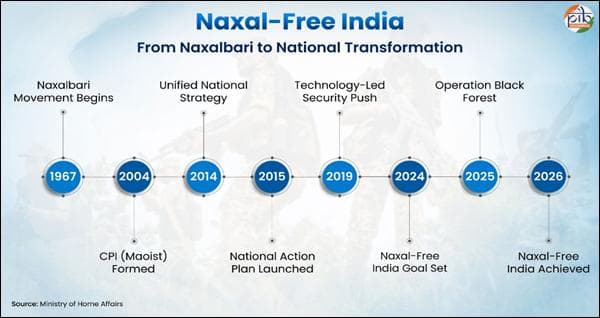
- The Naxalbari uprising began in West Bengal in 1967.
- The National Policy and Action Plan to address LWE was approved in 2015.
- India had 126 LWE-affected districts in 2014.
- Thirty-eight districts are categorised as legacy and thrust districts.
- The LWE-specific road schemes constructed 15,189 km of roads.
Left-Wing Extremism Naxal-free India: why in the news?
The government declared India effectively Naxal-free on 31 March 2026, meeting a target set in August 2024, marking a historic shift in internal security after nearly six decades of Left-Wing Extremism.
India has become effectively free from Left-Wing Extremism (LWE), with no district in the country classified as LWE-affected as of 31 March 2026, the Ministry of Home Affairs said. The milestone was achieved on the target date set by the government on 24 August 2024. The transformation affects millions of tribal families and villages that had lived under the shadow of Naxal violence for nearly six decades.
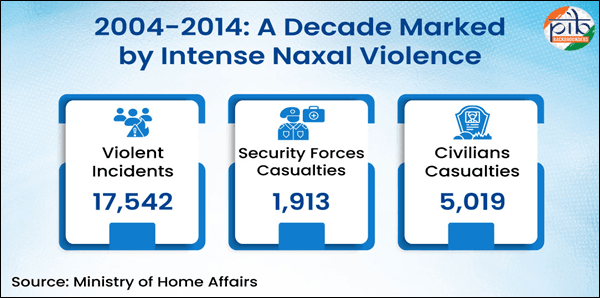
The government said the number of LWE-affected districts fell from 126 in 2014 to zero by March-April 2026. Reported violent incidents dropped from 870 in 2014 to 33 by 29 July 2026, and fatalities fell from 310 to 12 over the same comparison. The decade from 2004 to 2014 had recorded 17,542 violent incidents, 1,913 security force deaths and 5,019 civilian deaths, with violence peaking in 2010 at 1,936 incidents and 720 civilian deaths.
The government attributed the turnaround to a comprehensive strategy approved in 2015 under the National Policy and Action Plan, replacing an earlier fragmented approach. The strategy rested on three mutually reinforcing strands: restoring trust in the state through security operations and rehabilitation, expanding infrastructure and governance presence, and delivering welfare and inclusive development. Under the Special Central Assistance scheme, approximately ₹4,318.52 crore has been released since 2017. The Security Related Expenditure scheme released ₹3,877.98 crore since 2014-15, and projects worth ₹1,761 crore were sanctioned under the Special Infrastructure Scheme.
Key features and how it works
- Security Related Expenditure (SRE) Scheme: reimburses recurring security costs of States, including operations and training, transport and logistics, community policing, Special Police Officers and Village Defence Committees, ex-gratia payments, rehabilitation of surrendered cadres and publicity. Since 2014-15, ₹3,877.98 crore has been released to States under it, as per the MHA page.PIB
- Special Infrastructure Scheme (SIS): sanctions projects to strengthen Special Forces, Special Intelligence Branches, District Police and Fortified Police Stations in erstwhile LWE-affected States. Projects worth ₹1,761 crore have been sanctioned under it.PIB
- Special Central Assistance (SCA) Scheme: addresses infrastructure and developmental gaps in former LWE-affected districts, such as roads, bridges, school buildings, Anganwadi centres, primary health centres and drinking-water facilities. The most affected districts got ₹30 crore a year and districts of concern ₹10 crore a year. About 15,000 projects have been approved since 2017, with about 14,000 completed. A total of ₹4,318.52 crore had been released as on August 2026.mha.gov.in
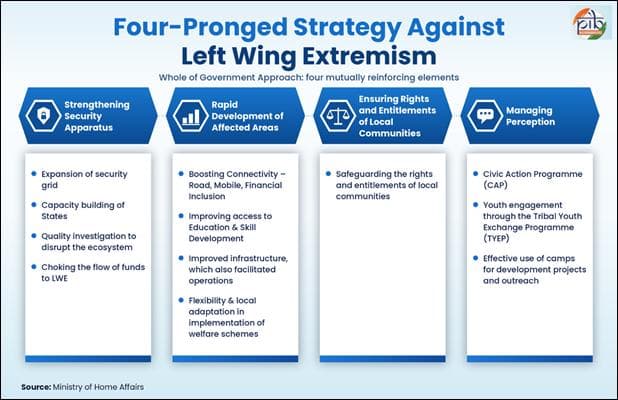
- Four-pronged strategy: strengthening the security apparatus, rapid development, ensuring rights and entitlements, and managing perception. Central Armed Police Forces are deployed to consolidate security gains.PIB
- Post-LWE phase: the focus has shifted to saturating government schemes in LWE-free areas, livelihoods, strengthening Panchayati Raj, support for victims and surrendered cadres, and countering LWE ideology in urban areas.mha.gov.in
Related Static GK and comparison
- Ministry of Home Affairs: the ministry responsible for internal security. Central Armed Police Forces, including CRPF, are under its administrative control.
- Left Wing Extremism Division: established in the Ministry of Home Affairs on 19 October 2006 to address LWE through a coordinated security and development approach.mha.gov.in
- Naxalbari uprising: 1967, West Bengal, the origin of the Naxalite movement; CPI (Maoist) was formed in 2004 through the merger of the People's War Group and the Maoist Communist Centre of India.
- Red Corridor: the Naxal influence zone in central and eastern India, which Wikipedia records as having peaked at nearly 180 districts in the late 2000s.
NPAP-linked LWE schemes compared
| Basis | Security Related Expenditure (SRE) | Special Central Assistance (SCA) | Special Infrastructure Scheme (SIS) |
|---|---|---|---|
| Purpose | Reimburses recurring counter-LWE security and rehabilitation costs of States | Fills infrastructure and service gaps in former LWE districts | Sanctions projects for special forces, intelligence and police infrastructure |
| Funds released or sanctioned | ₹3,828.01 crore released since 2014-15 | ₹4,318.52 crore released since 2017 | ₹1,761 crore of projects sanctioned |
| Per-district limit | Not stated on the MHA page | ₹30 crore a year (most affected), ₹10 crore a year (districts of concern) | Not stated on the sources opened |
| Implementing body | Ministry of Home Affairs, LWE Division | Ministry of Home Affairs, LWE Division | Ministry of Home Affairs, LWE Division |
Achievements
- The government declared India effectively LWE-free on 31 March 2026.mha.gov.in
- Violence fell sharply from its 2010 peak of 1,936 incidents and 720 civilian deaths in one year.PIB
Challenges
- Preventing resurgence after the Naxal-free declaration is a key task, as the LWE Division's post-LWE focus on consolidation shows.mha.gov.in
- Development gaps in remote tribal areas that the earlier fragmented approach failed to close could feed fresh grievance if left unaddressed.
- Coordination between State Police and Central forces, which the plan identified as a gap, needs to be sustained over time.PIB
Way forward
- Outcome monitoring of schemes such as SCA in former LWE districts, to confirm that infrastructure translates into services.
- Handholding and rehabilitation of surrendered cadres so that they are reintegrated into mainstream life.mha.gov.in
- Convergence of central schemes in erstwhile LWE areas, the approach the LWE Division uses for development programmes of central ministries.mha.gov.in
Connected to this news
National Policy and Action Plan on Left-Wing Extremism (NPAP-2015)
The 2015 whole-of-government framework of the Ministry of Home Affairs to counter Left-Wing Extremism (Naxalism) through security, development and rights-based measures, for affected tribal and rural areas of India.
Timeline
24 November 2026This story
Government declared India effectively Naxal-free on 31 March 2026, with zero LWE-affected districts against 126 in 2014, marking the close of the NPAP-2015 framework.
31 March 2026
Government declared India effectively free from Left-Wing Extremism, with no LWE-affected district.
24 August 2024
Government set the target of making the country Naxal-free by 31 March 2026.
2017
Special Central Assistance scheme began, with releases counted from this year.
2015
National Policy and Action Plan approved, replacing the earlier ad hoc approach with a whole-of-government framework.
19 October 2006
Left Wing Extremism Division set up in the Ministry of Home Affairs.
LWE indicators: 2014 and 2026
| Indicator | 2014 | 2026 |
|---|---|---|
| Affected districts | 126 | Zero by March-April |
| Incidents | 870 | 33 through 29 July |
| Fatalities | 310 | 12 through 29 July |
Key terms
- Left-Wing Extremism:
- Left-Wing Extremism refers to violent extremist movements seeking political and social change through revolutionary means.
- Forest Rights Act:
- The Scheduled Tribes and Other Traditional Forest Dwellers (Recognition of Forest Rights) Act, 2006 recognises specified forest rights of eligible forest-dwelling communities.
- Eklavya Model Residential Schools:
- Eklavya Model Residential Schools provide residential education for Scheduled Tribe students.
- Special Central Assistance:
- Special Central Assistance supports public infrastructure and services in districts affected by Left-Wing Extremism.
Left-Wing Extremism Naxal-free India: why it matters for exams
Exams: UPSC, JPSC, SSC, Defence
Syllabus: Security: Left-Wing Extremism and internal security; Governance: Tribal welfare and last-mile delivery
Common mistake: Examiners may present zero LWE-affected districts as zero violent incidents: 33 incidents were recorded in 2026 through 29 July.
Mains practice questions
Question 1(GS-3 | 250 words | 15 marks)
Critically examine how the integrated strategy of security operations, infrastructure expansion and welfare-led development contributed to India's declaration of being effectively free from Left-Wing Extremism, and discuss the challenges that may still threaten sustained peace in former LWE areas.
Answer outline
- Introduction: Open by noting that the Ministry of Home Affairs declared India effectively Naxal-free on 31 March 2026, ending a conflict of nearly six decades, and that the reported fall from 126 affected districts in 2014 to zero reflects a shift from fragmented responses to an integrated approach.
- Body:
- Security dimension: targeted operations by Central Armed Police Forces and the Central Reserve Police Force, along with the National Investigation Agency and Enforcement Directorate action against funding networks, reduced violence from 870 incidents in 2014 to 33 by July 2026.
- Infrastructure and connectivity: 15,189 km of LWE-specific roads and Border Roads Organisation work extended state presence into remote terrain, enabling administration and reducing the isolation that sustained extremism.
- Welfare and inclusive development: Special Central Assistance, Special Infrastructure Scheme and Security Related Expenditure funds, along with surrender and rehabilitation policies (about 8,526 surrenders), addressed grievances that fed recruitment.
- Critical assessment: the outcome depends on the sequence of measures; security gains must be matched by durable tribal land, forest rights and livelihood outcomes, otherwise the vacuum may be refilled.
- Remaining challenges: monitoring of residual pockets, ensuring last-mile delivery of schemes, protecting tribal rights under the Forest Rights Act and PESA, and preventing resurgence through local governance and accountability.
- Conclusion: Sustained peace will depend on balancing firm security with genuine trust-building, so that development reaches the tribal population and the state's legitimacy in these areas is permanently consolidated.
Question 2(GS-3 | 250 words | 15 marks)
Discuss the significance of the 2015 National Policy and Action Plan's shift from a fragmented approach to a comprehensive three-pronged strategy, and evaluate whether this model can be replicated for other internal security challenges such as insurgency in the Northeast or terrorism in Jammu and Kashmir.
Answer outline
- Introduction: Open by stating that the 2015 National Policy and Action Plan replaced ad hoc responses with three mutually reinforcing strands (security, governance and infrastructure, and welfare), a shift linked to the sharp decline in LWE incidents.
- Body:
- Significance of the shift: earlier responses treated extremism mainly as a law and order problem, whereas the integrated model recognised that trust, development and security must move together.
- Coordination: the Ministry of Home Affairs as nodal ministry, with states responsible for police and land, showed how Centre-State coordination and funding schemes can align efforts.
- Replicability in the Northeast: insurgency there has distinct ethnic, cross-border and political roots, so welfare and infrastructure alone may not suffice; peace accords and political dialogue must be central.
- Replicability in Jammu and Kashmir: terrorism is shaped by cross-border sponsorship and a different political context, so the model needs adaptation, with stronger emphasis on counter-radicalisation and political processes.
- Caution: transplanting a model requires assessing local drivers of conflict rather than assuming uniform causes.
- Conclusion: The LWE experience offers a useful framework of calibrated force, development and trust-building, but its success in other theatres will depend on context-specific adaptation and genuine political engagement.
Stuck? Get it in one tap
Left-Wing Extremism involves groups using violence to pursue revolutionary political change. The government combined security operations with roads, schools, welfare and support for people who surrendered. No district remained classified as affected by March-April 2026, although incidents were still recorded later in 2026.
- Security: Left-Wing Extremism and internal security
- Governance: Tribal welfare and last-mile delivery
Related concepts: Left-Wing Extremism, Forest Rights Act, Eklavya Model Residential Schools, Special Central Assistance
Practice questions
Pick an answer, then read the explanation.
- Q1Easy
Which ministry coordinates the National Policy and Action Plan to address Left-Wing Extremism?
Explanation: The Ministry of Home Affairs coordinates the national framework for addressing Left-Wing Extremism. The other ministries are not the coordinating ministry for this plan.
- Q2Hard
Consider the following statements about India's Left-Wing Extremism strategy:
- 1. The National Policy and Action Plan was approved in 2015.
- 2. The number of LWE-affected districts was 126 in 2014.
- 3. No LWE-related violent incident was recorded in 2026 through 29 July.
Which of the statements given above are correct?
Explanation: Statements 1 and 2 are correct: the plan was approved in 2015 and 126 districts were classified as affected in 2014. Statement 3 is incorrect because 33 incidents were recorded through 29 July 2026.
- Q3Medium
How many legacy and thrust districts continue to receive security and developmental support after the reduction in LWE-affected districts?
Explanation: A total of 38 districts are categorised as legacy and thrust districts for continued support. The figure of 35 refers to the earlier count of most-affected districts.
- Q4Medium
What is the principal objective of converting security camps into integrated development centres in formerly LWE-affected areas?
Explanation: Integrated development centres are intended to provide access to government services, healthcare, skills and livelihood opportunities. Their purpose is broader than combat training, police training or intelligence gathering.
Frequently asked questions
1. When did India become effectively free from Naxalism?
The government marked 31 March 2026 as the date India became effectively free from Naxalism.
2. How many districts continue to receive support after being affected by LWE?
Thirty-eight districts are categorised as legacy and thrust districts and continue to receive security and developmental support.
3. What are the four pillars of India's LWE strategy?
The pillars are strengthening security, rapid development, ensuring rights and entitlements, and managing perception.
4. What financial support is provided to surrendered LWE cadres?
Higher-ranked cadres receive an immediate ₹5 lakh grant and others ₹2.5 lakh, alongside ₹10,000 per month for 36 months. Additional surrender and weapon-deposit incentives are also provided.
All sources
- Original24 November 2026 · Read story

