

Source: PIB
Subject: Governance, Digital Governance and Social Justice Schemes|Target exams: UPSC, SSC
Key points for Prelims: SAMAVESH, e-Anudaan portal, PFMS (Public Financial Management System), BHASHINI, DigiLocker, PM-AJAY
Mains syllabus mapping
- General Studies Paper 2: Government policies and interventions for development in sectors such as welfare of vulnerable sections; e-governance applications, use of technology in governance and service delivery
- General Studies Paper 2: Issues relating to development and management of Social Sector/Services relating to Health, Education, Human Resources and welfare schemes for SCs, STs and vulnerable sections
Single Access Mechanism for All Verticals of Empowerment & Social Harmony (SAMAVESH): quick facts
- Full form
- Single Access Mechanism for All Verticals of Empowerment & Social Harmony
- Parent ministry
- Ministry of Social Justice and Empowerment
- Implementing body
- Department of Social Justice and Empowerment (DoSJE)
Key facts for one-day exams
- SAMAVESH is scheduled for launch on 25 November 2026.
- The Department of Social Justice and Empowerment developed SAMAVESH.
- SAMAVESH will integrate more than 20 departmental portals.
- Samajik Sahayak will support more than 22 regional languages.
- The new e-Anudaan portal will cover grant-in-aid processes under four schemes.
SAMAVESH and e-Anudaan portal: why in the news?
The Union Minister is scheduled to launch SAMAVESH and the new e-Anudaan portal on 25 November 2026, marking a planned shift to a unified digital gateway for social justice schemes and streamlined grant management.
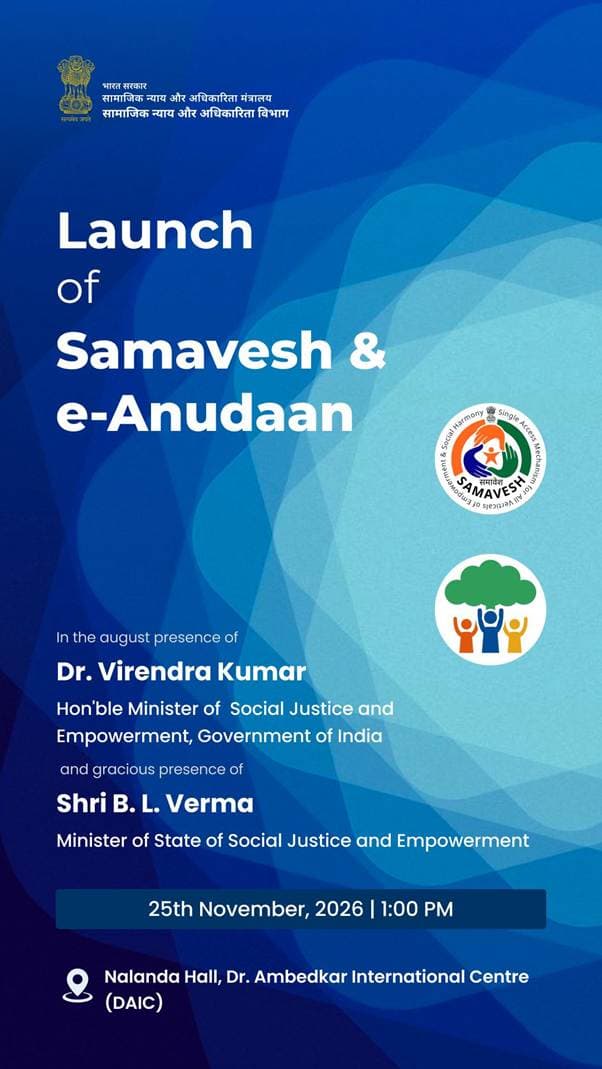
Union Minister for Social Justice and Empowerment Dr Virendra Kumar, along with Minister of State B. L. Verma, will launch SAMAVESH and the new e-Anudaan portal on 25 November 2026 at Dr Ambedkar International Centre in New Delhi. The platforms, developed by the Department of Social Justice and Empowerment, are designed to strengthen the digital governance ecosystem of the department, a senior official said.
SAMAVESH, which stands for Single Access Mechanism for All Verticals of Empowerment & Social Harmony, will integrate more than 20 departmental portals, including nine that provide end-to-end digital workflows for various schemes. It will feature a common login facility and an AI-powered chatbot called Samajik Sahayak, which will provide information and assistance in more than 22 regional languages through integration with BHASHINI. The platform will also connect with DigiLocker and the Public Financial Management System (PFMS) and include a consolidated Beneficiary Dashboard for monitoring.
The new e-Anudaan portal will bring grant-in-aid processes under four schemes, National Action Plan for Drug Demand Reduction (NAPDDR), SMILE, Atal Vayo Abhyuday Yojana (AVYAY) and SHRESHTA, onto a single digital platform. It will simplify application procedures, minimise documentation, introduce automated document verification and provide e-Inspection facilities including video-based inspections and geo-tagged evidence. Integration with PFMS will enable end-to-end tracking of fund disbursements.
The launch event will also feature the exchange of two memoranda of understanding. The first, between the Department of Social Justice and Empowerment and BHASHINI, will facilitate multilingual accessibility. The second, between the department and the National Skill Development Corporation (NSDC), will support skilling and employment under the grant-in-aid component of the Pradhan Mantri Anusuchit Jaati Abhyuday Yojana (PM-AJAY).
Key features and how it works
- Common login facility: users access multiple services through one unified authentication mechanism.PIB
- Samajik Sahayak: an AI-powered chatbot giving information and help in more than 22 regional languages, integrated with BHASHINI.PIB
- Integration with DigiLocker and the Public Financial Management System (PFMS) will facilitate access to services.PIB
- Consolidated Beneficiary Dashboard for monitoring, tracking and oversight of scheme implementation.PIB
Related Static GK and comparison
- Department of Social Justice and Empowerment (DoSJE): a department under the Ministry of Social Justice and Empowerment associated with SAMAVESH.dosje.gov.in
- Ministry of Social Justice and Empowerment: the parent ministry, renamed in May 1998 from the Ministry of Welfare. Its minister holds cabinet rank in the Council of Ministers.
- National Skill Development Corporation (NSDC): a not-for-profit public limited company incorporated on 31 July 2008 under a public-private partnership model.
- DigiLocker: a cloud document service provided by the Ministry of Electronics and Information Technology under Digital India, which provides access to certified digital documents.
- Digital India: the government programme launched by Prime Minister Narendra Modi on 1 July 2015, administered by MeitY, under which many state and national digital platforms are built.
- e-Anudaan: the new portal of the department that moves grant-in-aid processes under NAPDDR, SMILE, AVYAY and SHRESHTA onto one digital platform, with PFMS integration for fund tracking.PIB
SAMAVESH compared with DigiLocker, a national digital gateway
| Basis | SAMAVESH | DigiLocker |
|---|---|---|
| Administering body | Department of Social Justice and Empowerment | Ministry of Electronics and Information Technology (MEITY) |
| Scope | Schemes, services and portals of one department (more than 20 portals) | Certified digital documents from many government and private issuers |
| Identity requirement | Common login facility (no detail on identity method stated in the source) | Users need an Aadhaar number, verified by OTP on the linked mobile number |
| Languages | Chatbot in more than 22 regional languages through BHASHINI | Not stated in the source |
| Launch | Scheduled for 25 November 2026 | Public launch on 1 July 2015 (beta in February 2015) |
Achievements
- SAMAVESH consolidates more than 20 departmental portals into one gateway, which reduces the number of separate sites a citizen has to visit.PIB
- Its integration with BHASHINI and the Samajik Sahayak chatbot makes department services available in more than 22 regional languages, which widens access for citizens who do not read English or Hindi.PIB
- The e-Anudaan portal's automated document verification and PFMS-linked tracking aim to shorten processing of grant-in-aid proposals and make fund disbursement traceable end to end.PIB
Challenges
- Digital access gaps: a platform with an AI chatbot and online workflows reaches only those with internet access and digital skills, so the most vulnerable users may still need offline help.
- Trust in grant processes: NGOs and voluntary organisations need confidence that automated verification and video inspection are applied fairly, which depends on clear rules and staff training.
Way forward
- Outcome monitoring: use the consolidated Beneficiary Dashboard to track whether services reach the intended people, not just whether applications are filed.
- Handholding for users: set up assisted access at offices and through community workers, so that digital services do not exclude the least digitally literate.
- Convergence with other platforms: keep linking SAMAVESH with DigiLocker, PFMS and BHASHINI, and with skilling partners such as NSDC, so that beneficiaries get several services through one route.
Connected to this news
Single Access Mechanism for All Verticals of Empowerment & Social Harmony (SAMAVESH)
SAMAVESH is a unified digital gateway of the Department of Social Justice and Empowerment that gives citizens, beneficiaries and stakeholders single access to the department's schemes, services and portals.
Timeline
24 November 2026This story
SAMAVESH unified gateway and e-Anudaan grant portal are scheduled for launch by Dr Virendra Kumar, with MoUs with BHASHINI and NSDC to be exchanged at the event.
1998
The Ministry of Welfare was renamed the Ministry of Social Justice and Empowerment in May 1998.
SAMAVESH and new e-Anudaan
| Feature | SAMAVESH | e-Anudaan |
|---|---|---|
| Main function | Unified access to departmental services | Grant-in-aid management |
| Key users | Citizens and beneficiaries | NGOs and assisted institutions |
| Key feature | Common login and multilingual chatbot | Automated verification and e-inspection |
Key terms
- Grant-in-aid:
- Financial assistance provided to an organisation or institution for an approved purpose.
- Public Financial Management System:
- A government digital platform that supports financial management and tracking of public funds.
- Geo-tagging:
- The attachment of geographical location information to an item such as a photograph or digital record.
- Common login:
- An authentication facility that lets a user access multiple services using a unified login mechanism.
SAMAVESH and e-Anudaan portal: why it matters for exams
Exams: UPSC, SSC
Syllabus: Governance: E-governance and service delivery; Society: Welfare schemes and social inclusion
Common mistake: Examiners may present SAMAVESH as the four-scheme grant portal and e-Anudaan as the general citizen gateway; the roles are the reverse.
Mains practice questions
Question 1(GS-2 | 250 words | 15 marks)
Digital integration of welfare delivery through single-window platforms such as SAMAVESH and e-Anudaan can improve transparency and efficiency but also creates new challenges of access and exclusion. Critically examine.
Answer outline
- Introduction: Open by noting that the Department of Social Justice and Empowerment is moving grant-in-aid and scheme delivery onto a unified digital gateway, which promises convenience but depends on digital literacy and connectivity.
- Body:
- Benefits: single access mechanism, common login, consolidated beneficiary dashboard, automated document verification and reduced documentation for applicants.
- Transparency and accountability: integration with PFMS enables end-to-end tracking of fund disbursement, and e-Inspection with geo-tagged evidence reduces scope for manipulation.
- Inclusion through language: AI-powered chatbot in regional languages via BHASHINI can help citizens who are not comfortable with English or formal documentation.
- Challenges: digital divide, low digital literacy among intended beneficiaries, dependence on DigiLocker and Aadhaar-linked records that may exclude those lacking documents, and risks of data privacy.
- Need for complementary measures: assisted access through Common Service Centres, grievance redressal, and periodic audit of exclusion errors.
- Conclusion: Digital gateways can strengthen welfare governance if paired with assisted access, data protection and grievance mechanisms, so that technology widens rather than narrows the reach of schemes.
Question 2(GS-2 | 150 words | 10 marks)
Discuss how integrating grant-in-aid schemes such as NAPDDR, SMILE, AVYAY and SHRESHTA on a single platform can improve governance of social sector programmes.
Answer outline
- Introduction: Note that the e-Anudaan portal brings four separate grant schemes onto one digital platform to simplify procedures and monitor fund flow.
- Body:
- Simplified application and reduced documentation lower the transaction cost for implementing agencies and NGOs.
- Automated verification and e-Inspection with video and geo-tagged evidence improve quality of monitoring.
- PFMS integration allows real-time tracking of disbursements and reduces diversion or delay of funds.
- Linking grants with skilling through the NSDC memorandum under PM-AJAY broadens outcomes beyond cash transfers.
- Conclusion: A single platform with strong monitoring can make social sector grants more accountable, provided capacity building of implementing agencies keeps pace with the digital tools.
Stuck? Get it in one tap
SAMAVESH is a planned single gateway for social justice schemes and services. Its chatbot will help users access information in several languages. The new e-Anudaan portal will help organisations apply for grants and allow officials to track payments and inspect projects digitally.
- Governance: E-governance and service delivery
- Society: Welfare schemes and social inclusion
Related concepts: Grant-in-aid, Public Financial Management System, Geo-tagging, Common login
Practice questions
Pick an answer, then read the explanation.
- Q1Easy
Which department developed the planned SAMAVESH digital gateway?
Explanation: The Department of Social Justice and Empowerment developed SAMAVESH. The department works under the Ministry of Social Justice and Empowerment.
- Q2Hard
Consider the following statements about the planned SAMAVESH and e-Anudaan portals:
- 1. SAMAVESH will provide a common login for multiple services.
- 2. The new e-Anudaan portal will use video-based inspections and geo-tagged evidence.
- 3. Samajik Sahayak is designed to provide assistance only in English.
Which of the statements given above is/are correct?
Explanation: Statements 1 and 2 are correct: common login is a SAMAVESH feature, and e-Anudaan will support technology-enabled inspections. Statement 3 is incorrect because Samajik Sahayak is designed to assist in more than 22 regional languages.
- Q3Medium
How many departmental portals will provide end-to-end digital workflows within the planned SAMAVESH gateway?
Explanation: Nine portals provide end-to-end workflows for schemes and programmes. SAMAVESH will integrate more than 20 portals overall; seven, eight and ten are not the workflow count.
- Q4Medium
What is the main purpose of integrating PFMS with the new e-Anudaan portal?
Explanation: PFMS integration will enable end-to-end tracking of disbursements and payments, supporting financial accountability. Multilingual assistance, video inspections and common login are separate platform features.
Frequently asked questions
1. What does SAMAVESH stand for?
SAMAVESH stands for Single Access Mechanism for All Verticals of Empowerment & Social Harmony.
2. What will the new e-Anudaan portal cover?
The portal will bring grant-in-aid processes under NAPDDR, SMILE, AVYAY and SHRESHTA onto one digital platform.
3. What is Samajik Sahayak in SAMAVESH?
Samajik Sahayak is a planned artificial intelligence-powered chatbot that will offer information and assistance in more than 22 regional languages through BHASHINI integration.
4. When are SAMAVESH and the new e-Anudaan portal scheduled to launch?
The platforms are scheduled for launch on 25 November 2026.
All sources
- Original24 November 2026 · Read story


