

Source: PIB
Subject: Science and Technology (Space Technology) and Indian Economy (Infrastructure, Private Sector Participation)|Target exams: UPSC
Key points for Prelims: IN-SPACe (Indian National Space Promotion and Authorization Centre), New Space India Limited, PM Gati Shakti National Master Plan, National Quantum Mission, Skyroot Aerospace (maiden launch vehicle flight, 18 July 2026), Indian Space Association
Mains syllabus mapping
- General Studies Paper 3: Science and Technology: developments and their applications; space technology, indigenisation, private sector participation in space
- General Studies Paper 3: Indian Economy: growth, infrastructure, industrial policy and the services sector; PM Gati Shakti for infrastructure planning

Key facts for one-day exams
- India’s space economy is currently valued at nearly USD 9 billion.
- The projected space economy is USD 40-45 billion in less than a decade.
- India’s space ecosystem has approximately 400-500 companies.
- The Indian Space Association organised the fifth India International Space Conclave on 23-24 November 2026.
- The National Quantum Mission was launched in 2023 with an eight-year mandate.
India space economy projection: why in the news?
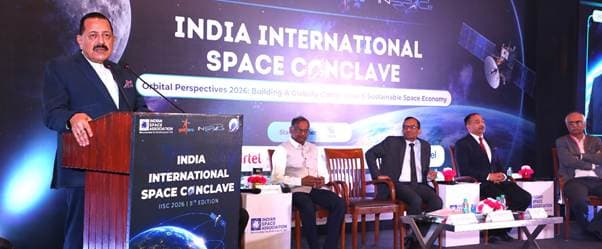
Dr. Jitendra Singh projected India's space economy to grow from nearly USD 9 billion to USD 40-45 billion in less than a decade at the India International Space Conclave 2026, highlighting the expansion of private-sector participation and the launch of the 'Space Economy 2036: The India Blueprint' report.
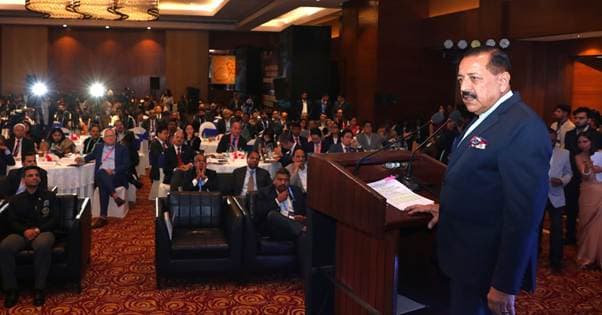
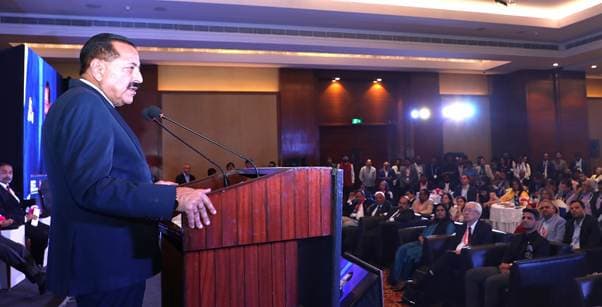
India’s space economy, currently valued at nearly USD 9 billion, is projected to grow to USD 40-45 billion in less than a decade, Union Minister of State (Independent Charge) for Science and Technology and Earth Sciences Dr. Jitendra Singh said on November 24, 2026. Addressing the fifth India International Space Conclave 2026 in New Delhi, the Minister said the space ecosystem has expanded from single-digit startups to approximately 400-500 companies in just a few years, driven by reforms initiated under Prime Minister Narendra Modi. The two-day conclave, organised by the Indian Space Association on November 23-24, also saw the launch of the report 'Space Economy 2036: The India Blueprint'.
Dr. Jitendra Singh said the establishment of New Space India Limited, the creation of the Indian National Space Promotion and Authorization Centre (IN-SPACe) and the opening of the space sector to private participation marked a decisive transformation. He cited Skyroot's maiden launch vehicle flight on July 18, 2026, its multi-mission launch agreement and unicorn status as milestones, along with Agnikul and other companies developing advanced propulsion systems, privately built rocket engines, earth-observation technologies and satellite imaging capabilities. The Minister said space technology’s economic contribution must be measured not only through rocket launches and satellite manufacturing but also through savings and efficiencies across sectors, citing the PM Gati Shakti National Master Plan for improved infrastructure planning, reduced costs and minimised wastage. He also noted that India had achieved 1,000 kilometres in secure quantum communication in three years under the National Quantum Mission, launched in 2023 with an eight-year target of 2,000 kilometres.
Key features and how it works
- Single window: IN-SPACe promotes, enables, authorises and supervises space activities of private entities, including building launch vehicles and satellites, space-based services, sharing of ISRO/DoS space infrastructure, and setting up new space facilities.
- Technology Adoption Fund (TAF): a ₹500 crore fund announced in February 2025 to help space technology companies, with a focus on startups and MSMEs developing commercially viable products.
- Satellite Bus as a Service (SBaaS): launched in April 2025 so that private firms can design and develop small satellite bus platforms for hosted payloads, reducing dependence on imported satellite buses.
- Ground Station as a Service (GSaaS): IN-SPACe is examining private use of ground stations on ISRO property, with operations outsourced to specialised providers on subscription or pay-per-use terms. It approved Dhruva Space's GSaaS application.
Related Static GK and comparison
- NewSpace India Limited (NSIL): established on 6 March 2019, a Public Sector Undertaking under the Department of Space whose main aim is to scale up private sector participation in Indian space programmes.
- Department of Space: established in 1972, it brought ISRO under its management on 1 June 1972 and administers the Indian space programme.
- Anusandhan National Research Foundation and the Research, Development and Innovation (RDI) Fund: enabling mechanisms cited by the Minister for research and private participation in space.PIB
Achievements
- The space ecosystem has grown from single-digit startups to about 400-500 companies, which the Minister linked to the reforms under PM Modi.PIB
- Private firm Skyroot reached a maiden launch vehicle flight on 18 July 2026, a key milestone for private participation in launches.PIB
- IN-SPACe has given private firms an authorised path into ground station services and small satellite bus platforms through GSaaS and SBaaS.
Challenges
- The Minister said the perceived lack of demand for space services was largely linked to insufficient awareness of practical applications of space technology.PIB
- Dependence on foreign satellite buses and components needs to be reduced, which is why SBaaS was launched; the gap is still being closed.
- The Minister urged domestic private players to scale up investment in the space sector and encouraged industry to facilitate greater overseas investment.PIB
Way forward
- Outcome monitoring: track how many authorisations and private launches convert into commercial results, so that the space economy target is measured by real output.
- Support startups and MSMEs through the Technology Adoption Fund in developing commercially viable space technology products.
- Convergence with other ministries: the Minister stated that space applications span infrastructure, railways, defence and health, so inter-ministerial use of space data can widen demand.PIB
Connected to this news
Indian National Space Promotion and Authorisation Centre
IN-SPACe is a single-window autonomous nodal agency under the Department of Space that promotes, authorises and supervises private space activities in India.
Timeline
24 November 2026This story
The space economy is now valued near USD 9 billion and is projected to reach USD 40-45 billion within a decade, with about 400-500 companies in the ecosystem.
April 2025
IN-SPACe launched the Satellite Bus as a Service (SBaaS) initiative.
February 2025
IN-SPACe announced the ₹500 crore Technology Adoption Fund.
11 October 2021
PM Modi launched the Indian Space Association as a single-window agency for space business for startups and the private sector.
June 2020
Union Cabinet decided to open the space sector to Indian private participation and created IN-SPACe as a single-window nodal agency.
6 March 2019
NewSpace India Limited was established under the Department of Space.
India’s space economy: current and projected
| Measure | Current | Projected |
|---|---|---|
| Economic value | Nearly USD 9 billion | USD 40-45 billion |
| Time horizon | Current estimate | Less than a decade |
Key terms
- Space economy:
- The space economy encompasses activities and services that create value through space-related technology, infrastructure and applications.
- Earth observation:
- Earth observation involves collecting information about the Earth, including through sensors carried by satellites.
- IN-SPACe:
- The Indian National Space Promotion and Authorization Centre facilitates and authorises space activities by non-government entities in India.
- Corporate social responsibility:
- Corporate social responsibility refers to companies’ responsibilities and activities directed towards social and community welfare.
India space economy projection: why it matters for exams
Exams: UPSC
Syllabus: Science and Technology: Space technology and its applications; Economy: Infrastructure and private investment
Common mistake: Examiners may present USD 40-45 billion as the current size of India’s space economy; it is a projection, while the current value is nearly USD 9 billion.
Mains practice questions
Question 1(GS-3 | 250 words | 15 marks)
Critically examine the role of institutional reforms such as IN-SPACe and New Space India Limited in opening India's space sector to private participation. What challenges must be addressed for the sector's projected growth to materialise?
Answer outline
- Introduction: Open by noting that the Minister projected India's space economy to grow from nearly USD 9 billion to USD 40-45 billion in under a decade, a shift made possible by opening the sector to private firms.
- Body:
- Institutional reforms: IN-SPACe as the single-window promotional and regulatory authority, and New Space India Limited as the commercial arm of ISRO for technology transfer and industry collaboration.
- Growth of the ecosystem from a few startups to about 400-500 companies, with Skyroot's July 2026 maiden launch and unicorn status as evidence of viability.
- Challenges: capital access and long gestation periods in deep-tech ventures, dependence on government contracts, licensing and authorisation delays, and the need for clear data and spectrum policies.
- Gaps in skilled talent, testing and launch infrastructure, and the protection of intellectual property for start-ups using public-funded knowledge.
- Need for regulatory predictability, risk-sharing finance and procurement policies favouring domestic private firms.
- Conclusion: Institutional reform has created a credible foundation, but sustaining the projected growth will depend on deepening capital markets, predictable regulation and a steady pipeline of commercial demand beyond government missions.
Question 2(GS-3 | 150 words | 10 marks)
Discuss how space technology contributes to economic growth beyond launch vehicles and satellite manufacturing, with reference to infrastructure planning and governance. Evaluate the significance of the PM Gati Shakti National Master Plan in this context.
Answer outline
- Introduction: Note the Minister's point that the economic value of space technology lies in savings and efficiencies across sectors, not only in rockets and satellites.
- Body:
- Direct contributions: satellite manufacturing, launch services, earth-observation and satellite imaging products.
- Indirect contributions: geospatial data improving infrastructure planning, reducing costs and minimising wastage.
- PM Gati Shakti National Master Plan integrates spatial data across ministries to rationalise infrastructure projects and avoid duplication.
- Other applications include secure communication through the National Quantum Mission and disaster management and agriculture uses of satellite data.
- Conclusion: Space technology's greatest economic value lies in its use as an enabling input for governance and planning, with Gati Shakti showing how spatial data can turn into efficiency gains across the economy.
Stuck? Get it in one tap
India’s space economy includes activities that create value from space technology and its applications. Private companies can participate in areas such as rockets, satellite imaging and propulsion. Space-based information can also help plan infrastructure and improve public services.
- Science and Technology: Space technology and its applications
- Economy: Infrastructure and private investment
Related concepts: Space economy, Earth observation, IN-SPACe, Corporate social responsibility
Practice questions
Pick an answer, then read the explanation.
- Q1Hard
Consider the following statements about India’s space economy in 2026:
- 1. The space economy is currently valued at nearly USD 9 billion.
- 2. Its projected value is USD 40-45 billion in less than a decade.
- 3. The estimated number of space companies is 40-50.
Which of the statements given above is/are correct?
Explanation: Statements 1 and 2 are correct: the present estimate is nearly USD 9 billion and the projected value is USD 40-45 billion. Statement 3 is incorrect because the estimated number of companies is approximately 400-500.
- Q2Medium
What is the projected size of India’s space economy in less than a decade, as stated in 2026?
Explanation: India’s space economy is projected to reach USD 40-45 billion in less than a decade. The current estimate is nearly USD 9 billion; the other ranges do not match the projection.
Frequently asked questions
1. What is the current estimated size of India’s space economy?
India’s space economy is estimated at nearly USD 9 billion.
2. How many companies are estimated to be in India’s space ecosystem?
India’s space ecosystem has approximately 400-500 companies.
3. What role does IN-SPACe play in India’s space sector?
IN-SPACe facilitates and authorises space activities by non-government entities.
4. How does space technology support PM Gati Shakti?
Space-based applications help improve infrastructure planning, project timelines and resource efficiency.
All sources
- Original24 November 2026 · Read story


