

Source: PIB
Subject: Indian Economy: Agriculture and Allied Sectors, Cooperatives and Rural Livelihoods|Target exams: UPSC, UPPSC, SSC
Key points for Prelims: National Dairy Development Board (NDDB), Operation Flood / White Revolution, Milk Producer Organisations (MPOs), Verghese Kurien, GOBARdhan
Mains syllabus mapping
- General Studies Paper 3: Agriculture and allied sectors: dairy sector growth, livestock productivity, value addition and marketing; Cooperative-based rural development
- General Studies Paper 2: Government policies and interventions for development in sectors; Role of women and rural livelihoods; Cooperatives and Ministry of Cooperation
Key facts for one-day exams
- National Milk Day is observed every year on 26 November.
- Dr. Verghese Kurien is known as the Father of India's White Revolution.
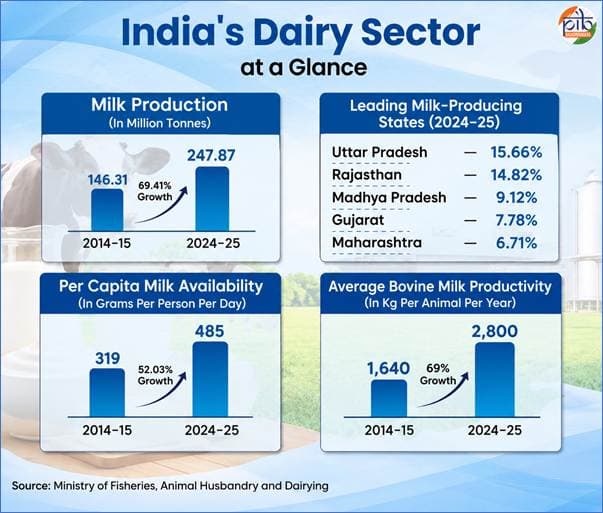
- India produced 247.87 million tonnes of milk in 2024-25.
- Uttar Pradesh contributed 15.66% of India's milk production in 2024-25.
- White Revolution 2.0 targets 75,000 new dairy cooperative societies by 2028-29.
National Milk Day and dairy sector: why in the news?
National Milk Day on 26 November provides the occasion to review India's dairy sector performance, including record milk production of 247.87 million tonnes in 2024-25 and the progress of White Revolution 2.0, which targets 75,000 new dairy cooperative societies by 2028-29.
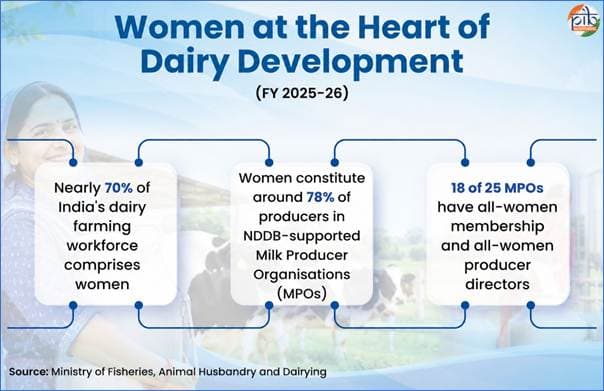
India observes National Milk Day on 26 November, commemorating the birth anniversary of Dr. Verghese Kurien, the architect of the White Revolution. The day honours the contribution of dairy farmers and the cooperative movement that has made India the world's largest milk producer, contributing nearly one-fourth of global production. According to the Ministry of Fisheries, Animal Husbandry and Dairying, the sector supports 8.5 crore rural households, with women comprising nearly 70 percent of the dairy farming workforce.
Milk production rose from 146.31 million tonnes in 2014-15 to 247.87 million tonnes in 2024-25, a compound annual growth rate of 5.41 percent. Per capita milk availability increased from 319 grams per person per day to 485 grams, and average bovine milk productivity grew from 1,640 kilograms per animal per year to 2,800 kilograms. The top five milk-producing states, Uttar Pradesh (15.66 percent), Rajasthan (14.82 percent), Madhya Pradesh (9.12 percent), Gujarat (7.78 percent), and Maharashtra (6.71 percent), together accounted for 54.09 percent of total production.
The dairy cooperative network comprises 22 milk federations, 241 district cooperative milk unions, 28 marketing dairies, and 25 Milk Producer Organisations, covering approximately 2.45 lakh villages and 1.65 crore dairy farmers. As of 31 October 2026, dairy cooperatives recorded daily milk procurement of 690.90 lakh kg and liquid milk sales of 462.95 lakh litres. The National Dairy Development Board's subsidiary, NDDB Dairy Services, has established 25 Milk Producer Organisations, 18 of which have all-women membership, covering over 13 lakh producers across 175 districts in 12 states.
Key features and how it works
- Creates new dairy cooperative societies in villages and Panchayats not yet covered, and strengthens existing societies, through the village, district union and state federation tiers.PIB
- Works to increase milk procurement by dairy cooperatives by 50 percent over five years, improve market access and generate rural employment.PIB
- Promotes women's empowerment in dairying; women make up nearly 70 percent of the dairy farming workforce.PIB
- Promotes sustainability and circularity through the 'Gold out of Garbage' idea, converting cattle dung and farm residue into biogas, organic manure and bio-fertilisers.PIB
- Works through two multi-state cooperatives: Cooperative Inputs and Services Delivery Multi-State Limited (inputs such as feed, disease control and artificial insemination) and Gomay Sahkari Samiti Multi-State Limited (scientific management of cattle dung).PIB
Related Static GK and comparison
- NDDB Dairy Services: wholly owned, not-for-profit subsidiary of NDDB that incorporates and operationalises Milk Producer Organisations (farmer-owned Producer Companies).PIB
- Anand Pattern: the three-tier cooperative model of village dairy societies, district unions and a state federation, on which the dairy cooperative network is built.
- GOBARdhan (National Circular Bioenergy Scheme): launched on 01 October 2026 with an outlay of ₹23,731 crore for FY 2026-27 to FY 2035-36, aiming to scale up compressed biogas production.PIB
White Revolution 2.0 compared with Operation Flood and NPDD
| Basis | White Revolution 2.0 | Operation Flood (Phase I) | National Programme for Dairy Development (NPDD) |
|---|---|---|---|
| Launch year | Formally launched 25 December 2024 | 1970 (launched 13 January 1970) | February 2014 |
| Implementing body | Department of Animal Husbandry and Dairying (cooperative-led) | NDDB | Department of Animal Husbandry and Dairying |
| Main target | 75,000 new dairy cooperative societies by 2028-29 | Link 18 milk sheds with metro consumers; Phase I cost ₹1.16 billion | Restructured 2021-22 to 2025-26; Component B outlay ₹1,568.28 crore in 9 states |
| Funding | Funded under NPDD | EEC-donated skimmed milk powder and butter oil via WFP | Component B includes ₹924.56 crore JICA ODA loan |
Achievements
- By 31 October 2026, 24,097 new dairy cooperative societies had been formed and 31,394 existing societies strengthened under the programme.PIB
- Milk production rose from 146.31 million tonnes in 2014-15 to 247.87 million tonnes in 2024-25, the base on which White Revolution 2.0 builds.PIB
- Under NDDB Dairy Services, 25 Milk Producer Organisations have been established, 18 with all-women membership.PIB
Challenges
- Coverage of uncovered villages and Panchayats is the core gap, and new societies may struggle to remain viable without steady procurement volumes.
- Regional imbalance: milk production is concentrated in a few states, so cooperative build-out must reach states with lower current coverage.
- Low survival of new units: newly formed societies need governance, accounting and marketing skills to keep working after formation.
Way forward
- Handholding support for new societies on governance, accounting and market access during their early years.
- Convergence with GOBARdhan and other schemes so that cattle dung and farm residue create extra income for dairy cooperatives.
Connected to this news
White Revolution 2.0 (White Revolution 2.0 is a cooperative-led dairy programme; also known as Operation Flood 2.0, Sweet Revolution, Dhavalkranti 2.0)
White Revolution 2.0 is a cooperative-led dairy initiative, launched to expand dairy cooperative coverage in uncovered villages and Panchayats, meant for India's milk producers and rural dairy farmers.
Timeline
25 November 2026This story
National Milk Day review: milk output hit 247.87 million tonnes in 2024-25, and White Revolution 2.0 targets 75,000 new dairy cooperative societies by 2028-29.
25 December 2024
White Revolution 2.0 formally launched.
19 September 2024
SOP for White Revolution 2.0 launched.
July 2021
NPDD restructured for implementation from 2021-22 to 2025-26.
February 2014
National Programme for Dairy Development (NPDD) implemented from February 2014.
1998
India becomes the world's largest milk producer, surpassing the United States.
India's dairy indicators: 2014-15 and 2024-25
| Indicator | 2014-15 | 2024-25 |
|---|---|---|
| Milk production | 146.31 million tonnes | 247.87 million tonnes |
| Per capita daily availability | 319 grams | 485 grams |
| Annual bovine milk productivity | 1,640 kg per animal | 2,800 kg per animal |
Key terms
- Dairy cooperative:
- A producer-owned organisation through which members collectively procure, process or market milk and access related services.
- White Revolution:
- The transformation of India's dairy sector associated with increased milk production and the development of dairy cooperatives.
- Per capita milk availability:
- The average quantity of milk available per person, expressed here in grams per day.
- Circular bioeconomy:
- An approach that uses biological resources and organic residues efficiently, including their conversion into energy and useful products.
National Milk Day and dairy sector: why it matters for exams
Exams: UPSC, UPPSC, SSC
Syllabus: Agriculture: Animal husbandry and dairy development; Economy: Cooperatives and rural livelihoods
Common mistake: Examiners may present Rajasthan as the leading milk-producing state in 2024-25; Uttar Pradesh ranked first with 15.66%, while Rajasthan contributed 14.82%.
Mains practice questions
Question 1(GS-3 | 250 words | 15 marks)
Despite record growth in milk production, India's dairy sector faces challenges in productivity, marketing and inclusion of small producers. Critically examine the role of the cooperative model in sustaining the White Revolution and suggest measures to make the next phase of dairy development more inclusive and productive.
Answer outline
- Introduction: Open by noting that National Milk Day (26 November) honours Dr. Verghese Kurien and that India's milk output rose from 146.31 million tonnes in 2014-15 to 247.87 million tonnes in 2024-25, making it the world's largest producer, to frame the cooperative model's achievements and gaps.
- Body:
- Strengths of the cooperative model: a three-tier structure of village societies, district unions and federations (22 federations, 241 district unions) that assures producers a fair price and market access, reaching about 2.45 lakh villages and 1.65 crore farmers.
- Role in productivity and income: average bovine productivity rose from 1,640 to 2,800 kg per animal per year, supported by NDDB-led breeding, feed and veterinary services, lifting per capita availability from 319 to 485 grams per day.
- Inclusion of women and small producers: women form nearly 70 percent of the dairy workforce, and 18 of 25 Milk Producer Organisations have all-women membership, showing the model's potential for gender-inclusive rural livelihoods.
- Persisting challenges: regional concentration (top five states hold 54.09 percent of output), uneven cooperative penetration, low productivity compared with global benchmarks, cold-chain and value-addition gaps, and dependence of small farmers on informal intermediaries.
- Measures for the next phase: expand Milk Producer Organisations and strengthen weaker societies as envisaged under White Revolution 2.0, invest in animal genetics, fodder and cold chains, promote value addition and digital payments, and integrate waste-to-energy initiatives such as GOBARdhan.
- Conclusion: The cooperative model has proven that collective ownership can deliver growth with equity, and a balanced way forward lies in combining its proven governance with technology, infrastructure and inclusive financing to sustain the White Revolution 2.0.
Question 2(GS-2 | 150 words | 10 marks)
Discuss how the National Milk Day and the White Revolution 2.0 can contribute to rural livelihoods, women's empowerment and the circular economy. Evaluate the role of initiatives such as GOBARdhan in this context.
Answer outline
- Introduction: Link National Milk Day's tribute to Dr. Verghese Kurien and the dairy sector's support to 8.5 crore rural households to the wider goal of inclusive rural development.
- Body:
- Rural livelihoods: dairy supports 8.5 crore rural households and provides a steady cash income that cushions small and marginal farmers against agricultural distress.
- Women's empowerment: women constitute nearly 70 percent of dairy farming workforce, and all-women Milk Producer Organisations covering over 13 lakh producers in 175 districts enhance their decision-making and bargaining power.
- Circular economy: GOBARdhan, with an outlay of ₹23,731 crore for FY 2026-27 to FY 2035-36, converts cattle dung and organic waste into biogas, compost and energy, reducing environmental pollution and creating additional income.
- Challenges: unequal access to credit, technology and markets, and the need for better convergence between dairy, energy and waste management schemes.
- Conclusion: Integrating dairy growth with women-led cooperatives and waste-to-wealth initiatives like GOBARdhan offers a sustainable route to rural prosperity, provided implementation is monitored and benefits reach the most vulnerable producers.
Stuck? Get it in one tap
Dairy cooperatives allow milk producers to organise procurement, processing and sales. White Revolution 2.0 aims to extend these cooperatives to more villages and increase their milk procurement. GOBARdhan supports the conversion of cattle dung and other organic resources into clean energy and useful products.
- Agriculture: Animal husbandry and dairy development
- Economy: Cooperatives and rural livelihoods
Related concepts: Dairy cooperative, White Revolution, Per capita milk availability, Circular bioeconomy
Practice questions
Pick an answer, then read the explanation.
- Q1Easy
Which organisation is the parent of NDDB Dairy Services, which facilitates Milk Producer Organisations?
Explanation: NDDB Dairy Services is a wholly owned, not-for-profit subsidiary of the National Dairy Development Board. The other options are government ministries or a department, rather than its parent board.
- Q2Hard
Consider the following statements about White Revolution 2.0:
- 1. Its activities are funded under the National Programme for Dairy Development.
- 2. It targets 75,000 new dairy cooperative societies by 2028-29.
- 3. It seeks a 50% increase in cooperative milk procurement over five years.
Which of the statements given above are correct?
Explanation: All three statements are correct: the programme funds the envisaged activities, and the initiative sets both the society and procurement targets. The other combinations omit at least one correct statement.
- Q3Medium
What was India's milk production in 2024-25?
Explanation: India produced 247.87 million tonnes of milk in 2024-25. The figure of 146.31 million tonnes relates to 2014-15; 168 lakh litres per day was a chilling-capacity figure, and 241 was the number of district cooperative milk unions.
- Q4Medium
What is the principal objective of GOBARdhan, the National Circular Bioenergy Scheme?
Explanation: GOBARdhan promotes clean energy and rural prosperity through the use of organic resources. Milk testing, bovine breeding and dairy marketing are addressed through other dairy-sector interventions.
Frequently asked questions
1. Why is National Milk Day observed on 26 November?
The day commemorates the birth anniversary of Dr. Verghese Kurien, known as the Father of India's White Revolution.
2. Which state led India's milk production in 2024-25?
Uttar Pradesh led with 15.66% of national milk production.
3. What is the White Revolution 2.0 target for dairy cooperative societies?
The initiative aims to establish 75,000 new societies and strengthen 46,422 existing societies by 2028-29.
4. What is the outlay for the National Circular Bioenergy Scheme GOBARdhan?
The scheme has an outlay of ₹23,731 crore for FY 2026-27 to FY 2035-36.
All sources
- Original25 November 2026 · Read story


