

Tags:Science & TechUPSC
Source: PIB
Subject: Science and Technology, Health and Public Health Interventions (Snakebite Management)|Target exams: UPSC
Key points for Prelims: Bivalent antivenom, Pit vipers (Trimeresurus), Institute of Advanced Study in Science and Technology (IASST), Department of Science and Technology, Big Four snakes, F(ab)2 antivenom
Mains syllabus mapping
- General Studies Paper 2: Health, Government policies and interventions for development in health sector, Public health and Health Infrastructure
- General Studies Paper 3: Science and Technology: developments and their applications, Biotechnology, indigenous research and development
Key facts for one-day exams
- The bivalent antivenom targets two northeastern pit viper species.
- Pope's pit viper is scientifically named Trimeresurus popeiorum.
- The red-tailed bamboo pit viper is scientifically named Trimeresurus erythrurus.
- Prof. Ashis K. Mukherjee led the antivenom research team.
- The Institute of Advanced Study in Science and Technology is located in Guwahati.
Northeast India pit viper antivenom: why in the news?
A research team has developed and tested a bivalent antivenom targeting two pit viper species in Northeast India, where commercial antivenom has limited effectiveness. The study, published in a peer-reviewed journal, highlights the need for region-specific antivenoms and has implications for snakebite treatment in the region.
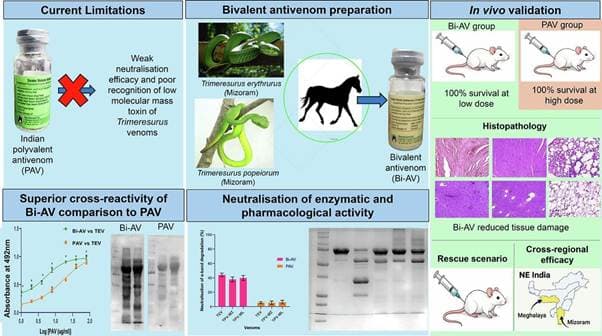
Researchers have developed a bivalent antivenom specifically effective against the venom of two pit viper species common in Northeast India, the Pope's pit viper (Trimeresurus popeiorum) and the red-tailed bamboo pit viper (Trimeresurus erythrurus). The novel antivenom, created by a team led by Prof. Ashis K. Mukherjee, Director of the Institute of Advanced Study in Science and Technology (IASST), Guwahati, an autonomous institute of the Department of Science and Technology, aims to address the limited effectiveness of commercial Indian polyvalent antivenom against several medically significant snakes in the region. The study was published in the International Journal of Biological Macromolecules.
In laboratory and preclinical investigations, the new equine F(ab)2 bivalent antivenom showed superior protection against pit viper envenomation compared to Indian polyvalent antivenom, which primarily targets the 'Big Four' snakes, Russell's viper, spectacled cobra, common krait, and saw-scaled viper. The novel antivenom significantly reduced disruptions in blood coagulation and injury to local and organ tissue. The venoms used for the research were collected from Mizoram and Meghalaya. The project involved collaboration between IASST, Premium Serums and Vaccines Pvt. Ltd., Amrita Research Center Delhi-NCR, Mizoram University, and Aaranyak, Guwahati. Prof. Mukherjee stated that additional clinical and regulatory testing will be necessary before the antivenom is routinely used on patients.
What is India's 'Big Four' snakebite framework?
The 'Big Four' refers to the four snake species responsible for the majority of severe envenomation and deaths in India: Russell's viper, spectacled cobra, common krait, and saw-scaled viper. Indian polyvalent antivenom is raised against the venoms of these four species. This framework was established because these snakes are widely distributed across the country and cause the highest burden of snakebite mortality and morbidity. The concept has guided antivenom production in India for decades, though it does not account for regionally significant venomous species like the pit vipers found in the Northeast.
Why is a region-specific antivenom needed for Northeast India?
Snakebite is a major public health concern in Northeast India, which is home to a wide variety of venomous snakes. The World Health Organization regards snakebite as a neglected tropical disease and a medical emergency. However, commercial Indian polyvalent antivenom primarily targets the 'Big Four' snakes, Russell's viper, spectacled cobra, common krait, and saw-scaled viper, and has shown limited effectiveness against several medically significant venomous snakes in Northeast India, including the two pit viper species targeted by the new antivenom.
What did the study find about the new antivenom's effectiveness?
In laboratory and preclinical studies, the bivalent antivenom demonstrated superior protection against pit viper envenomation compared to Indian polyvalent antivenom. It significantly reduced blood coagulation disruptions and injury to local and organ tissue. The research team, which included academic and industry partners, emphasized that the findings support a region-specific approach to antivenom development, but do not establish routine clinical effectiveness.
What is the next step before the antivenom can be used on patients?
Prof. Mukherjee stated that further clinical and regulatory testing is necessary before the novel antivenom can be routinely used on patients. The study underscores the importance of developing region-specific antivenoms based on the snakes that cause severe envenomation in various parts of India, particularly in Northeast India, where many medically significant species fall outside the conventional 'Big Four' paradigm.
New bivalent and Indian polyvalent antivenom
| Feature | New bivalent antivenom | Indian polyvalent antivenom |
|---|---|---|
| Main targets | Two northeastern pit vipers | Big Four snakes |
| Pit viper protection | Superior in preclinical investigations | Lower in comparative investigations |
| Development status | Further clinical testing needed | Commercially marketed |
Key terms
- Antivenom:
- A preparation containing antibodies or antibody fragments used to counteract the effects of animal venom.
- Bivalent antivenom:
- An antivenom designed to act against venoms from two specified species or types.
- Preclinical study:
- Research conducted before clinical testing in humans to investigate a product's properties, including safety and biological effects.
- Neglected tropical disease:
- A disease or condition that disproportionately affects vulnerable populations, particularly in tropical and subtropical regions, and requires focused public health attention.
Northeast India pit viper antivenom: why it matters for exams
Exams: UPSC
Syllabus: Science and Technology: Biotechnology and medical research; Society: Public health and neglected diseases
Common mistake: Examiners may present the antivenom as approved for routine patient use; it has shown preclinical promise and still requires clinical and regulatory testing.
Mains practice questions
Question 1(GS-2 | 250 words | 15 marks)
Critically examine why commercial polyvalent antivenom may fail to protect against region-specific snakes, and evaluate how region-specific research such as the bivalent pit viper antivenom developed in Northeast India can strengthen snakebite management in India.
Answer outline
- Introduction: Open by noting that snakebite is a major public health burden in India and that a Northeast-focused bivalent antivenom has been developed because commercial polyvalent antivenom targets mainly the 'Big Four' snakes.
- Body:
- Explain the limitation of polyvalent antivenom: it is built around a few medically significant snakes and may not neutralise venom of regionally prevalent species such as the pit vipers.
- Highlight the regional relevance: the Pope's pit viper and red-tailed bamboo pit viper venoms were studied using samples from Mizoram and Meghalaya, showing venom variation across geography.
- Discuss the research outcome: the F(ab)2 bivalent antivenom showed better protection than Indian polyvalent antivenom, reducing coagulation disruption and tissue injury.
- Evaluate the gaps: clinical trials and regulatory approval are still needed before routine use, and production, cost and cold-chain logistics must be considered.
- Suggest policy steps: regional venom mapping, public-private collaboration among institutes, manufacturers and universities, and strengthened rural treatment infrastructure.
- Conclusion: Conclude that region-specific antivenoms, backed by clinical validation and regulatory support, can make snakebite care more effective, provided they are integrated into a wider public health strategy.
Question 2(GS-3 | 150 words | 10 marks)
Discuss the role of institutional collaboration between autonomous research bodies, private manufacturers, academic institutions and NGOs in translating laboratory research into public health solutions, with reference to the Northeast India antivenom project.
Answer outline
- Introduction: Begin by stating that the bivalent antivenom was developed through a multi-institutional effort, showing how science translates into health tools.
- Body:
- Identify the collaborators: IASST Guwahati under the Department of Science and Technology, Premium Serums and Vaccines Pvt. Ltd., Amrita Research Center, Mizoram University and Aaranyak.
- Explain the roles: research and design, manufacturing, field venom collection, academic support and biodiversity expertise.
- Note the translation gap: preclinical success must pass clinical and regulatory testing before patient use.
- Conclusion: Conclude that such partnerships are essential for indigenous biotechnology, but sustained funding and regulatory support are needed to move from lab to clinic.
Stuck? Get it in one tap
Antivenom contains antibodies or their fragments that counteract venom. The new antivenom targets two pit viper species found in Northeast India and performed better than Indian polyvalent antivenom in preclinical tests. It still needs further testing before routine use in patients.
- Science and Technology: Biotechnology and medical research
- Society: Public health and neglected diseases
Related concepts: Antivenom, Bivalent antivenom, Preclinical study, Neglected tropical disease
Practice questions
Pick an answer, then read the explanation.
- Q1Easy
The Institute of Advanced Study in Science and Technology, which led the pit viper antivenom research, is an autonomous institute of which department?
Explanation: The Institute of Advanced Study in Science and Technology is an autonomous institute of the Department of Science and Technology. The other departments are not its parent department.
- Q2Hard
Consider the following statements about the Northeast India-specific pit viper antivenom:
- 1. It targets Trimeresurus popeiorum and Trimeresurus erythrurus.
- 2. It has completed all clinical and regulatory testing required for routine patient use.
- 3. It showed superior protection to Indian polyvalent antivenom in laboratory and preclinical investigations.
Which of the statements given above are correct?
Explanation: Statements 1 and 3 are correct: the antivenom targets the two named pit vipers and showed superior preclinical protection. Statement 2 is incorrect because further clinical and regulatory testing is necessary.
- Q3Medium
How many pit viper species are specifically targeted by the new Northeast India-specific antivenom?
Explanation: The bivalent antivenom targets two species: Pope's pit viper and the red-tailed bamboo pit viper. The other numbers do not match its two specified targets.
- Q4Medium
Why was a region-specific pit viper antivenom developed for Northeast India?
Explanation: Commercial Indian polyvalent antivenom mainly targets the Big Four and has limited effectiveness against several medically significant northeastern snakes. The new antivenom targets two regional pit vipers, not cobras; it does not remove the need for clinical testing.
Frequently asked questions
1. Which snakes does the Northeast India-specific antivenom target?
It targets Pope's pit viper, Trimeresurus popeiorum, and the red-tailed bamboo pit viper, Trimeresurus erythrurus.
2. Which institute led the Northeast India pit viper antivenom research?
The Institute of Advanced Study in Science and Technology in Guwahati led the research under Prof. Ashis K. Mukherjee.
3. Is the new pit viper antivenom ready for routine patient use?
Further clinical and regulatory testing is necessary before routine use in patients.
4. Where were the venoms used for the Northeast pit viper antivenom collected?
The venoms were collected from Mizoram and Meghalaya.
All sources
- Original25 November 2026 · Read story


