

Source: PIB
Subject: Indian Economy: Industrial Policy, Manufacturing and Make in India, Incentive Schemes|Target exams: UPSC
Key points for Prelims: Production Linked Incentive (PLI) Scheme, Ministry of Heavy Industries, Domestic Value Addition (DVA) 50%, Advanced Automotive Technology (AAT), Champion OEMs and Component Champions
Mains syllabus mapping
- General Studies Paper 3: Indian Economy: Industrial growth, manufacturing sector, PLI schemes, Make in India, employment generation
- General Studies Paper 2: Government policies and interventions for development in industry; role of nodal ministries
Production Linked Incentive (PLI) Scheme: quick facts
- Administered by
- Department for Promotion of Industry and Internal Trade (DPIIT), with concerned line ministries; assessment by NITI Aayog and Indian Institute of Management Ahmedabad
- Coverage
- 14 sectors, from mobile phones and electronics to food products, pharmaceuticals, textiles and drones
- Employment outcome
- 8.49 lakh jobs by March 2026, against a target of 30.18 lakh (28%)
Key facts for one-day exams
- The Ministry of Heavy Industries administers PLI-Auto.
- The scheme's approved outlay is ₹25,938 crore.
- Eligible products require a minimum 50% Domestic Value Addition.
- Reported cumulative investment reached ₹52,806 crore by 30 September 2026.
- The scheme generated 77,755 employment opportunities.
PLI-Auto scheme: why in the news?
The Ministry of Heavy Industries reported that PLI-Auto incentive disbursement reached ₹4,385.28 crore in FY 2026-27 as of 25 November 2026, with cumulative investments surpassing the target, making it a key update on the government's flagship manufacturing incentive scheme.
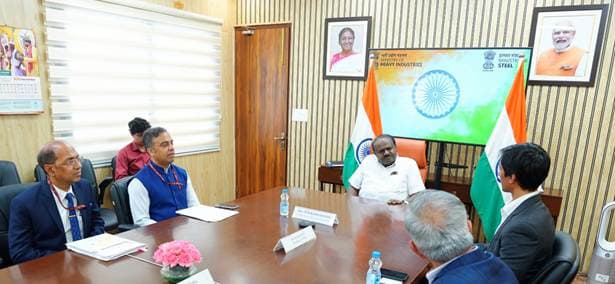
The Ministry of Heavy Industries has disbursed ₹4,385.28 crore in incentives under the Production Linked Incentive (PLI) Scheme for Automobile and Auto Component Industry during FY 2026-27 as of 25 November 2026. Union Minister for Heavy Industries and Steel, H. D. Kumaraswamy, chaired a review meeting with Additional Secretary Dr. Hanif Qureshi to assess the scheme's progress. The scheme, with a total approved budgetary outlay of ₹25,938 crore, aims to boost domestic manufacturing of advanced automotive technologies and position India as a global automobile hub.
Cumulative incentive disbursement since the scheme's inception has reached ₹6,771.64 crore. As of 30 September 2026, approved applicants reported cumulative investments of ₹52,806 crore, exceeding the target of ₹42,500 crore. The scheme has also generated incremental sales of ₹82,993 crore over the base year FY 2019-20 and created 77,755 employment opportunities. To qualify for incentives, eligible products must meet a minimum Domestic Value Addition (DVA) of 50%. As of 25 November 2026, DVA certificates have been issued to 9 Champion OEMs covering 139 products or variants, and 10 Component Champions covering 53 products or variants.
Key features and how it works
- The scheme gives performance-linked incentives on incremental sales of products made in domestic units, so payment follows output rather than being given up front.
- The 14 sectors include mobile manufacturing and specified electronic components, critical KSMs and APIs, medical devices, automobiles and auto components, pharmaceutical drugs, specialty steel, telecom and networking equipment, electronic and technology products, white goods, food products, textiles, high-efficiency solar PV modules, advanced chemistry cell (ACC) batteries, and drones and drone components.
- The government funds the scheme from its budget outlay, with each sector having its own outlay and tenure.
- Approved projects are spread across states including Andhra Pradesh, Haryana, Karnataka, Madhya Pradesh, Maharashtra, Tamil Nadu, Uttar Pradesh and Rajasthan.
Achievements
- Mobile phone exports rose from ₹22,870 crore in FY 2021 to about ₹2 lakh crore in FY 2025, showing strong results in electronics.
- India moved from being a net importer of key starting materials and APIs in FY 2022 to a net exporter in FY 2025.
- The food products scheme created 3.29 lakh jobs, the highest of any sector, and 76% of the investment target was achieved across the 14 schemes.
Challenges
- Job creation is well below target: 8.49 lakh of the 30.18 lakh target was reached, and several sectors such as automobiles created far fewer jobs than planned.
- China has challenged the schemes at the WTO, alleging that incentives tied to domestic inputs breach WTO subsidy rules.
Way forward
- Outcome monitoring: track jobs, investment and exports sector by sector against targets, and publish the results regularly.
- Handholding for beneficiary firms, especially new units, so that they survive and expand after the incentive period.
- Convergence with state industrial policies and skill programmes, so that job creation is matched with trained workers in the states where units are located.
Connected to this news
Production Linked Incentive (PLI) Scheme
The PLI scheme is a performance-linked incentive programme of the Government of India that pays companies for incremental sales of goods made in domestic units, to boost manufacturing, exports and employment in 14 key sectors.
Timeline
25 November 2026This story
Ministry of Heavy Industries reports PLI-Auto disbursement of ₹4,385.28 crore in FY 2026-27 and cumulative investment above target, with 50% domestic value addition required for incentives.
14 November 2026
NITI Aayog assessment (with IIM Ahmedabad) finds PLI schemes reached 28% of employment target and 76% of investment target by March 2026, with 18.51% of outlay disbursed.
Read the story14 November 2026
India's trade deficit with China reached $112 billion in 2025-26, up from $44 billion in 2020-21, prompting debate on fast-tracking business with Beijing while building domestic manufacturing under PLI.
Read the storyOctober 2025
China initiated a dispute at the WTO against PLI schemes for advanced chemistry cell batteries, automobiles and auto components, and electric vehicles.
April 2020
PLI scheme first introduced for mobile phone and electronics manufacturing.
March 2020
The PLI scheme was launched in March 2020 and later extended to schemes for 14 sectors.
Key terms
- Production Linked Incentive:
- A policy approach that links financial incentives to specified production or sales performance.
- Domestic Value Addition:
- The portion of a product's value added through domestic economic activity.
- Original Equipment Manufacturer:
- A manufacturer of original equipment or products, commonly abbreviated as OEM.
- Base year:
- A reference year against which changes in an economic measure are compared.
PLI-Auto scheme: why it matters for exams
Exams: UPSC
Syllabus: Economy: Industrial policy and manufacturing; Governance: Government schemes and implementation
Common mistake: Examiners may present ₹4,385.28 crore as cumulative disbursement; it is the FY 2026-27 disbursement up to 25 November 2026, while cumulative disbursement was ₹6,771.64 crore.
Mains practice questions
Question 1(GS-3 | 250 words | 15 marks)
Critically examine the Production Linked Incentive Scheme for the Automobile and Auto Component Industry as a tool for boosting domestic manufacturing. In your answer, discuss the role of the 50% Domestic Value Addition requirement in achieving the scheme's objectives.
Answer outline
- Introduction: Open by noting that the PLI-Auto scheme, with ₹25,938 crore outlay and cumulative disbursement of ₹6,771.64 crore, reflects the government's shift from tariff protection to incentive-linked manufacturing.
- Body:
- Achievements: investments of ₹52,806 crore against a target of ₹42,500 crore, incremental sales of ₹82,993 crore over FY 2019-20, and 77,755 jobs created.
- Role of the 50% DVA norm: it pushes localisation of components and deepens the domestic supplier base, linking incentives to real value creation rather than assembly.
- Critical concerns: a high DVA threshold may raise costs and discourage smaller players; reliance on a few Champion OEMs risks concentration of benefits.
- Dependence on imported advanced technologies and the need for sustained R&D and skilling to meet AAT goals.
- Scheme design lessons: periodic review, transparent certification (DVA certificates to 9 Champion OEMs and 10 Component Champions) and fiscal discipline in disbursement.
- Conclusion: A balanced way forward is to retain the DVA discipline while easing compliance for MSMEs, strengthening technology transfer and aligning the scheme with export competitiveness.
Question 2(GS-3 | 150 words | 10 marks)
Evaluate the role of incentive-based schemes like PLI in making India a global automobile hub. Suggest measures to address the challenges that may limit their long-term effectiveness.
Answer outline
- Introduction: Link the news of PLI-Auto's progress and the stated aim of positioning India as a global automobile hub to the broader debate on industrial incentives.
- Body:
- Contribution: attracting investment, generating employment and raising sales, as evidenced by the scheme's reported outcomes.
- Limitations: incentives are fiscally expensive, benefits may be captured by large firms, and global competitiveness depends on cost, quality and export markets.
- Measures: broaden participation for MSMEs, focus on export linkage, sustained R&D in Advanced Automotive Technology, and skilling for the workforce.
- Conclusion: Incentives can catalyse manufacturing, but durable global competitiveness requires complementary reforms in technology, skills and trade policy.
Stuck? Get it in one tap
PLI-Auto offers incentives to support advanced automobile and component manufacturing in India. Eligible products must have at least 50% domestic value addition, meaning a specified share of their value is added domestically. The scheme tracks investment, incremental sales and employment as indicators of progress.
- Economy: Industrial policy and manufacturing
- Governance: Government schemes and implementation
Related concepts: Production Linked Incentive, Domestic Value Addition, Original Equipment Manufacturer, Base year
Practice questions
Pick an answer, then read the explanation.
- Q1Easy
Which ministry administers the PLI Scheme for Automobile and Auto Component Industry?
Explanation: The Ministry of Heavy Industries administers PLI-Auto. The Ministry of Steel is a separate ministry, while the other two options are not the scheme's administering ministry.
- Q2Hard
Consider the following statements about the PLI Scheme for Automobile and Auto Component Industry:
- 1. Eligible products must meet a minimum 50% Domestic Value Addition requirement.
- 2. Incremental sales are measured over the FY 2019-20 base year.
- 3. The approved investment target was ₹52,806 crore.
Which of the statements given above are correct?
Explanation: Statements 1 and 2 are correct: the DVA minimum is 50% and the sales base year is FY 2019-20. Statement 3 is incorrect: ₹52,806 crore was reported cumulative investment, while the investment target was ₹42,500 crore.
- Q3Medium
What was the cumulative incentive disbursement under PLI-Auto as of 25 November 2026?
Explanation: Cumulative disbursement reached ₹6,771.64 crore. ₹4,385.28 crore was disbursed in FY 2026-27 up to that date; ₹25,938 crore was the approved outlay and ₹42,500 crore the investment target.
- Q4Medium
What is the primary purpose of the minimum Domestic Value Addition requirement under PLI-Auto?
Explanation: The minimum DVA requirement promotes domestic value addition in products qualifying for incentives. Incremental sales, the budgetary outlay and the investment target are separate scheme measures.
Frequently asked questions
1. What is the approved outlay for the PLI-Auto scheme?
The approved budgetary outlay is ₹25,938 crore.
2. What domestic value addition is required under PLI-Auto?
Eligible products must meet a minimum Domestic Value Addition of 50% to qualify for incentives.
3. How much investment was reported under PLI-Auto by September 2026?
Approved applicants reported cumulative investment of ₹52,806 crore as of 30 September 2026.
4. Which year is the base year for PLI-Auto incremental sales?
FY 2019-20 is the base year for measuring incremental sales.
All sources
- Original25 November 2026 · Read story


