

Source: PIB
Subject: Indian Economy: Infrastructure, Public Investment and Project Monitoring|Target exams: UPSC
Key points for Prelims: Central Repository of Infrastructure Projects (CRIP), PAIMANA monitoring platform, Harmonized Master List of Infrastructure, Ministry of Statistics and Programme Implementation, Mega projects (₹1,000 crore and above)
Mains syllabus mapping
- General Studies Paper 3: Infrastructure: energy, ports, roads, railways and their role in economic development; public investment and capital expenditure
- General Studies Paper 2: Government policies and interventions; governance and monitoring of central government schemes and projects
Central Repository of Infrastructure Projects (CRIP), a module of PAIMANA: quick facts
- Projects monitored (Oct 2026)
- 1,862 projects with total latest cost of ₹38.11 lakh crore across 17 Ministries/Departments; spending ₹17.87 lakh crore (46.88%)
- Mega and major split
- 790 mega projects (₹1,000 crore or more) and 1,072 major projects (below ₹1,000 crore)
- Full form
- Central Repository of Infrastructure Projects; a module of the PAIMANA platform launched 8 July 2026
Key facts for one-day exams
- The October 2026 flash report monitored 1,862 ongoing infrastructure projects.
- The monitored projects had a latest combined cost of ₹38.11 lakh crore.
- The report covered projects costing at least ₹150 crore.
- Water and Sanitation recorded an expenditure-to-cost ratio of 69.95%.
- PAIMANA-CRIP was launched in July 2026.
Central sector infrastructure projects monitoring: why in the news?
The Ministry of Statistics and Programme Implementation released the October 2026 monthly flash report on central-sector infrastructure projects, providing the latest data on project costs, expenditure, and progress across 17 ministries, which is crucial for tracking the government's infrastructure spending and implementation.
The Ministry of Statistics and Programme Implementation (MoSPI) has released its monthly flash report on central-sector infrastructure projects, monitoring 1,862 ongoing projects with a total latest cost of ₹38.11 lakh crore as of October 2026. The cumulative expenditure on these projects stands at ₹17.87 lakh crore, or approximately 46.88% of the total project cost, according to the ministry.
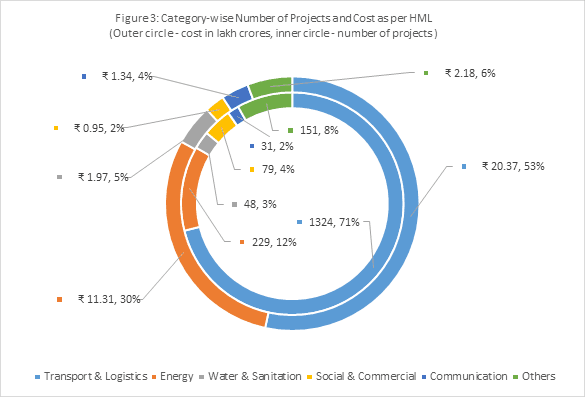
Of the monitored projects, 790 are mega projects costing ₹1,000 crore or more, while 1,072 are major projects below ₹1,000 crore. The transport and logistics sector accounts for the highest number of projects at 1,324, with a cost of ₹20.37 lakh crore, followed by the energy sector with 229 projects costing ₹11.31 lakh crore. Together, these two categories represent 83.41% of all projects and about 83.11% of the aggregate revised project cost.
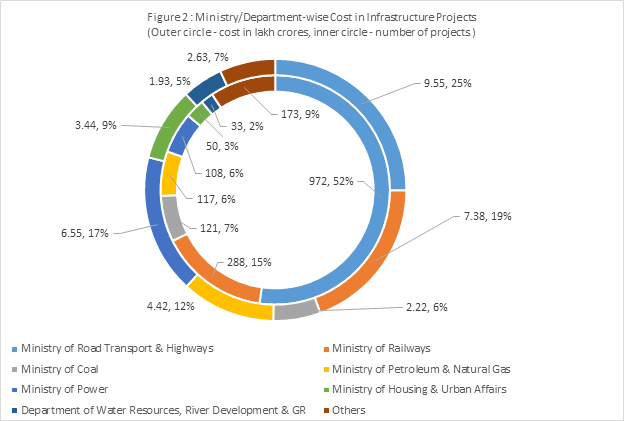
The Ministry of Road Transport and Highways leads with 972 projects, or 52% of the total, and a revised project cost of ₹9.55 lakh crore. The Ministry of Railways has 288 projects costing ₹7.38 lakh crore. Among Harmonized Master List categories, water and sanitation recorded the highest expenditure-to-cost ratio at 69.95%, followed by transport and logistics at 50.64% and communication at 48.78%.
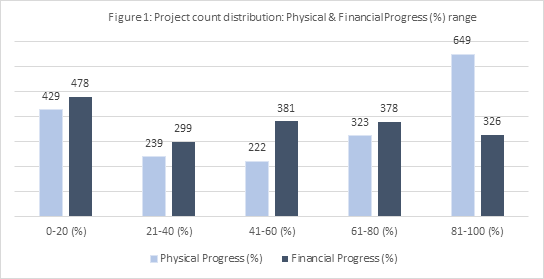
During October 2026, 38 additional projects were onboarded under the PAIMANA monitoring platform, including 23 from the Ministry of Road Transport and Highways. Notable new projects include the ₹4,464 crore eight-lane highway from Vadhavan Port to NH-48 and the ₹3,842.41 crore four-laning of the Badnawar-Petlawad-Thandla-Timarwani section in Madhya Pradesh. The ministry also reported that 649 projects have achieved over 80% physical progress, while 326 have crossed 80% financial completion.
Key features and how it works
- The flash report counts projects by physical progress (649 projects above 80%) and financial completion (326 projects above 80%), and compares expenditure with the latest project cost.PIB
Related Static GK and comparison
- PAIMANA (Project Assessment, Infrastructure Monitoring and Analytics for Nation-Building): launched 25 September 2025, developed by MoSPI, web-based platform for monitoring Central Sector infrastructure projects; replaced the earlier OCMS-2006 (Online Computerized Monitoring System).PIB
- Harmonized Master List of Infrastructure (2022): issued by the Department of Economic Affairs, the national classification framework for infrastructure sectors eligible for policy support and financing-related benefits; also used as the sector basis for PAIMANA's Performance Monitoring Dashboard.PIB
- Performance Monitoring Dashboard: launched 16 April 2026 on PAIMANA, covering six sub-sectors (Power, Civil Aviation, Telecommunications, Railways, Roads, Ports Shipping and Waterways) with 165 indicators, built with NIPFP.PIB
- Integrated Project Monitoring Portal (IPMP): DPIIT's earlier portal, replaced by the PAIMANA-CRIP module on 8 July 2026; PAIMANA's Project Monitoring vertical is still integrated with IPMP through API data exchange.PIB
CRIP/PAIMANA vs the earlier monitoring systems
| Basis | CRIP / PAIMANA (MoSPI) | IPMP (DPIIT) and OCMS-2006 |
|---|---|---|
| Implementing body | Ministry of Statistics and Programme Implementation | Department for Promotion of Industry and Internal Trade (IPMP); OCMS-2006 (earlier system) |
| Project threshold | Central Sector projects of ₹150 crore or more | Not stated on the pages opened |
| Launch | PAIMANA launched 25 September 2025; CRIP module 8 July 2026 | IPMP replaced on 8 July 2026; OCMS-2006 replaced by PAIMANA |
| Status | Current platform; project data integrated via API from ministries | Replaced; IPMP data flows into PAIMANA through API |
Achievements
- Over 60% of projects on PAIMANA are updated automatically through APIs from ministries' own MIS or web platforms, which reduces manual data entry.PIB
- The October 2026 flash report shows 46.88% of the total project cost spent, with 649 projects above 80% physical progress, indicating steady implementation of a large pipeline.PIB
- Project data for PRAGATI, PMG and other review mechanisms would subsequently be sourced and updated through PAIMANA-CRIP.PIB
Challenges
- Most of the monitored cost sits in a few sectors, so the report can hide slow progress in smaller sectors.
Way forward
- Continue API integration with the ministries' MIS platforms so that a larger share of project data updates without manual entry.
- Use the monthly review meetings and ministry-level dashboards to act early on projects that are behind schedule.
- Extend the Performance Monitoring Dashboard beyond the six sub-sectors so that outcome data is linked to project spending.
Connected to this news
Central Repository of Infrastructure Projects (CRIP), a module of PAIMANA
CRIP is MoSPI's central database of Central Sector infrastructure projects costing ₹150 crore and above, run through the PAIMANA platform, and the monthly flash report is its main public output.
Timeline
25 November 2026This story
MoSPI's October 2026 flash report shows 1,862 projects worth ₹38.11 lakh crore under CRIP, with 46.88% spent and 38 projects onboarded in October.
October 2026
October 2026 monthly flash report: 1,862 projects worth ₹38.11 lakh crore monitored; 38 projects onboarded in the month.
8 July 2026
PAIMANA-CRIP module launched, replacing DPIIT's Integrated Project Monitoring Portal (IPMP) and envisioned to evolve as the Central Repository of Infrastructure Projects.
16 April 2026
Performance Monitoring Dashboard launched on PAIMANA.
25 September 2025
PAIMANA launched as a web-based platform for monitoring Central Sector infrastructure projects, replacing OCMS-2006.
15 October 1999
Ministry of Statistics and Programme Implementation came into existence as an independent ministry after merging the Department of Statistics and the Department of Programme Implementation.
Infrastructure categories: October 2026
| Category | Projects | Latest cost | Expenditure ratio |
|---|---|---|---|
| Transport and logistics | 1,324 | ₹20.37 lakh crore | 50.64% |
| Energy | 229 | ₹11.31 lakh crore | 39.49% |
| Water and Sanitation | 48 | ₹1.97 lakh crore | 69.95% |
| Communication | 31 | ₹1.34 lakh crore | 48.78% |
| Social and Commercial | 79 | ₹0.95 lakh crore | 40.46% |
| Others | 151 | ₹2.18 lakh crore | 30.95% |
Key terms
- Physical progress:
- The proportion of project work completed, measured against the planned physical work.
- Financial progress:
- Project expenditure measured against the relevant project cost or financial plan.
- Harmonized Master List of Infrastructure:
- A list maintained by the Department of Economic Affairs that classifies infrastructure sectors and subsectors.
Central sector infrastructure projects monitoring: why it matters for exams
Exams: UPSC
Syllabus: Economy: Infrastructure and investment; Governance: Public project monitoring
Common mistake: Examiners may present 46.88% expenditure as physical completion; it is expenditure as a share of the latest project cost.
Mains practice questions
Question 1(GS-3 | 250 words | 15 marks)
Critically examine the role of centralised project monitoring platforms in improving the implementation of large public infrastructure projects. Discuss the challenges that continue to delay such projects despite better monitoring.
Answer outline
- Introduction: Open by noting that MoSPI's monthly flash report tracks 1,862 central-sector projects worth ₹38.11 lakh crore, showing that data-driven monitoring has become central to infrastructure governance.
- Body:
- Benefits of centralised monitoring: a single repository (CRIP) and the PAIMANA platform give real-time visibility on cost, expenditure and physical progress, enabling early intervention
- Evidence from the report: cumulative expenditure at about 46.88% of project cost and 649 projects above 80% physical progress show both progress and pending gaps
- Sectoral concentration: transport and logistics (1,324 projects) and energy (229 projects) dominate, so monitoring intensity must match the scale of risk
- Persistent challenges: land acquisition, forest and environmental clearances, cost overruns, coordination among multiple ministries and state governments, and gaps between reported and ground-level data
- Monitoring improves transparency but does not by itself ensure execution; it must be paired with administrative accountability and dispute resolution mechanisms
- Conclusion: Monitoring platforms are necessary but not sufficient; combining real-time data with decentralised execution capacity, timely clearances and accountability can convert visibility into timely delivery.
Question 2(GS-3 | 150 words | 10 marks)
Discuss the significance of public capital expenditure in infrastructure for sustaining economic growth in India. Evaluate how sector-wise variation in expenditure progress affects the outcomes of infrastructure investment.
Answer outline
- Introduction: Link the topic to the report's finding that central-sector projects are about 46.88% spent, showing that the pace of capital deployment matters for growth.
- Body:
- Multiplier effect: infrastructure spending raises demand, creates employment and lowers logistics costs, which supports productivity and private investment
- Sectoral variation: water and sanitation (69.95% expenditure ratio) and transport (50.64%) show uneven progress, implying differing returns and bottlenecks across sectors
- Transport and energy together account for over 83% of projects, so their delays have a disproportionate effect on the overall investment pipeline
- Risks of front-loaded or uneven spending include cost escalation and idle assets if completion lags
- Conclusion: Sustained public capital expenditure must be matched with sector-specific execution capacity so that growth gains are realised in a balanced manner.
Stuck? Get it in one tap
The infrastructure flash report tracks the cost, spending and work completed on selected central projects. Physical progress measures completed work, while financial progress measures spending. PAIMANA-PROJ monitors projects using data supported by the PAIMANA-CRIP repository.
- Economy: Infrastructure and investment
- Governance: Public project monitoring
Related concepts: Physical progress, Financial progress, Harmonized Master List of Infrastructure
Practice questions
Pick an answer, then read the explanation.
- Q1Easy
Which ministry monitors central-sector infrastructure projects through PAIMANA-PROJ?
Explanation: The Ministry of Statistics and Programme Implementation monitors the projects through PAIMANA-PROJ. The other ministries implement projects included in the monitoring framework.
- Q2Hard
Consider the following statements about the October 2026 central-sector infrastructure flash report:
- 1. Mega projects have a project cost of ₹1,000 crore or more.
- 2. Water and Sanitation has the highest expenditure-to-cost ratio among the listed Harmonized Master List categories.
- 3. The Others category is itself a Harmonized Master List category.
Which of the statements given above are correct?
Explanation: Statements 1 and 2 are correct: the mega-project threshold is ₹1,000 crore and Water and Sanitation records 69.95%. Statement 3 is incorrect because Others is an analytical category outside the Harmonized Master List.
- Q3Medium
How many ongoing projects were monitored in the October 2026 central-sector infrastructure flash report?
Explanation: The monitoring snapshot covered 1,862 ongoing projects. The figures 1,553 and 1,324 relate to transport and energy combined and transport alone; 38 projects were onboarded during October.
- Q4Medium
What is the main role of PAIMANA-CRIP in central infrastructure project monitoring?
Explanation: PAIMANA-CRIP is the data repository and input layer supporting PAIMANA-PROJ. The Department of Economic Affairs maintains the classification, while line ministries implement and commission their projects.
Frequently asked questions
1. What is the minimum project cost covered by the October 2026 infrastructure flash report?
The report covers selected central-sector infrastructure projects costing ₹150 crore and above.
2. What is the difference between PAIMANA-PROJ and PAIMANA-CRIP?
PAIMANA-PROJ is the project-monitoring interface. PAIMANA-CRIP is its underlying Central Repository of Infrastructure Projects.
3. Which infrastructure category had the highest expenditure-to-cost ratio in October 2026?
Water and Sanitation recorded 69.95%, the highest among the listed Harmonized Master List categories.
4. How many infrastructure projects were onboarded to PAIMANA in October 2026?
A total of 38 projects were onboarded, including 23 from the Ministry of Road Transport and Highways.
All sources
- Original25 November 2026 · Read story


